窨 (xūn) means "cellar / to scent (tea)" in Chinese. It has 14 strokes with the radical 穴.
Rated 4.2/5 in difficulty (advanced).
Appears in 3+ common words including 窨井 (xūn jǐng), 窨藏 (xūn cáng), 窨制 (xūn zhì).
Due to its 14 strokes, Hanzi Writer's error detection shows 窨 requires focused practice — most learners need 10+ attempts for consistent accuracy.
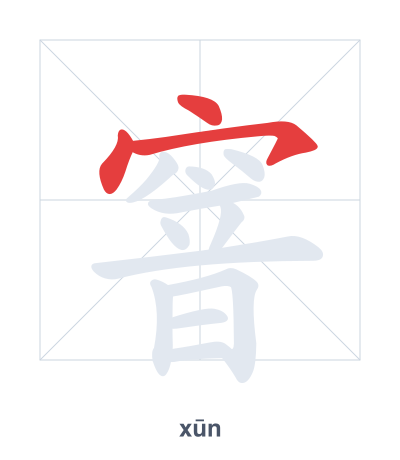
Open Hanzi Writer to see the animated stroke order and practice writing 窨 with real-time feedback.
The character 窨 (xūn) is written with 14 strokes. Follow the standard Chinese stroke order: top to bottom, left to right, outside before inside. The radical 穴 is one of its key components.
Practice the correct stroke order with the Hanzi Writer app to see animated stroke-by-stroke guidance with real-time feedback.
窨 means cellar / to scent (tea).
The character 窨 (xūn) combines the radical 穴 (cave/cellar) with 音 (sound). Originally it depicted an underground cellar where sounds echo, later extended to mean a place where tea leaves are stored with flowers to absorb fragrance (scenting tea).
💡 Memory Tip: Imagine a cave (穴) where you hear music (音) playing while tea leaves are being infused with floral scents.
路边有一个窨井盖。
lù biān yǒu yí gè xūn jǐng gài
There is a manhole cover by the roadside.
粮食被窨藏在地下。
liáng shí bèi xūn cáng zài dì xià
Grain is stored in an underground cellar.
这种茶是窨制出来的。
zhè zhǒng chá shì xūn zhì chū lái de
This tea is scented with flowers.
Open Hanzi Writer to see the animated stroke order and practice writing 窨 with real-time feedback.
✨ Animated stroke order · Handwriting recognition · HSK-graded practice · Free to use
The character 窨 is made of the radical 穴 (cave) on top and the component 音 (sound) below. The 穴 radical gives the meaning of 'underground space' like a cellar, while 音 provides the pronunciation xūn. Together, they form a character for a cellar or the process of storing things like tea underground to infuse them with fragrance.