窖 (jiào) means "A cellar or pit." in Chinese. It has 12 strokes with the radical 穴.
Rated 4.2/5 in difficulty (advanced).
Appears in 3+ common words including 地窖 (dì jiào), 酒窖 (jiǔ jiào), 冰窖 (bīng jiào).
Due to its 12 strokes, Hanzi Writer's error detection shows 窖 requires focused practice — most learners need 10+ attempts for consistent accuracy.
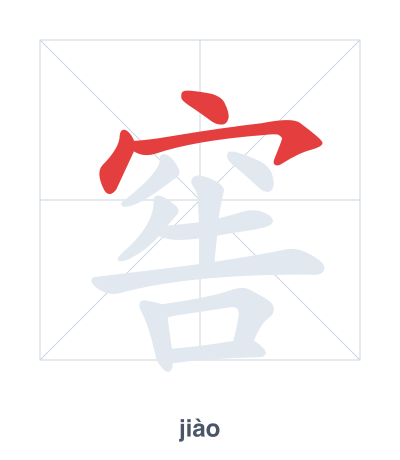
Open Hanzi Writer to see the animated stroke order and practice writing 窖 with real-time feedback.
The character 窖 (jiào) is written with 12 strokes. Follow the standard Chinese stroke order: top to bottom, left to right, outside before inside. The radical 穴 is one of its key components.
Practice the correct stroke order with the Hanzi Writer app to see animated stroke-by-stroke guidance with real-time feedback.
窖 means A cellar or pit..
The character 窖 is a compound of the radical 穴 (cave or hole) and the phonetic component 告 (originally a pictograph of an ox head on a speaking mouth, meaning 'to report'). Together, 穴 indicates an underground chamber, and 告 provides the sound (ancient *kˤuʔ-s, evolving to jiào), creating the meaning of a dug-out cellar or pit for storage.
💡 Memory Tip: A cave (穴) where you 'tell' (告) your deepest secrets because no one can hear you underground.
地窖里有白菜。
dì jiào lǐ yǒu bái cài
There is cabbage in the cellar.
参观私人酒窖。
cān guān sī rén jiǔ jiào
Visit a private wine cellar.
冰窖里很冷。
bīng jiào lǐ hěn lěng
It is very cold in the ice cellar.
Open Hanzi Writer to see the animated stroke order and practice writing 窖 with real-time feedback.
✨ Animated stroke order · Handwriting recognition · HSK-graded practice · Free to use
The top part is 穴 (cave or hole) and the bottom part is 告 (to report or announce). Together, they suggest an underground pit or cellar, a place where things are stored away. The 穴 radical hints at the underground nature, while 告 may imply a hidden or 'told' location.