井 (jǐng) means "a well" in Chinese. It has 4 strokes with the radical 二, and is HSK Level 6.
Rated 2.4/5 in difficulty (moderate).
Harder than 2% of HSK Level 6 characters.
Appears in 3+ common words including 水井 (shuǐ jǐng), 井水 (jǐng shuǐ), 井盖 (jǐng gài).
Hanzi Writer's stroke validation shows learners typically need 5-8 attempts to write 井 with correct proportion and order.
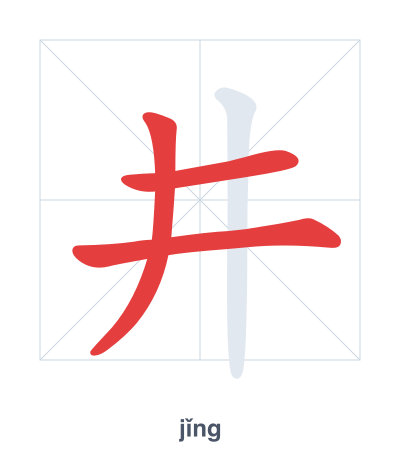
Open Hanzi Writer to see the animated stroke order and practice writing 井 with real-time feedback.
The character 井 (jǐng) is written with 4 strokes. Follow the standard Chinese stroke order: top to bottom, left to right, outside before inside. The radical 二 is one of its key components.
Practice the correct stroke order with the Hanzi Writer app to see animated stroke-by-stroke guidance with real-time feedback.
井 means a well.
As an HSK Level 6 character, 井 is an intermediate-level character.
井 is a pictograph that originally depicted the wooden frame or cross-beams used to line and reinforce a well's shaft, seen as a square grid pattern. The modern form retains the basic shape of four sides meeting at a central opening, symbolizing the well's structure.
💡 Memory Tip: Picture a square well with two crossed wooden planks overhead forming a # shape, where you drop a bucket through the center hole.
村里有一口水井。
cūn lǐ yǒu yī kǒu shuǐ jǐng
There is a water well in the village.
井水很凉快。
jǐng shuǐ hěn liáng kuài
The well water is very cool.
路上有一个井盖。
lù shàng yǒu yí gè jǐng gài
There is a manhole cover on the road.
Open Hanzi Writer to see the animated stroke order and practice writing 井 with real-time feedback.
✨ Animated stroke order · Handwriting recognition · HSK-graded practice · Free to use
The character 井 is a pictograph of an ancient well. It consists of two horizontal lines and two vertical lines that cross to form a square shape, representing the wooden frame used to support the well's walls.