恤 (xù) means "to sympathize" in Chinese. It has 9 strokes with the radical 忄, and is HSK Level 7.
Rated 4/5 in difficulty (challenging).
Harder than 40% of HSK Level 7 characters.
Appears in 3+ common words including 体恤 (tǐ xù), 抚恤 (fǔ xù), 怜恤 (lián xù).
Due to its 9 strokes, Hanzi Writer's error detection shows 恤 requires focused practice — most learners need 10+ attempts for consistent accuracy.
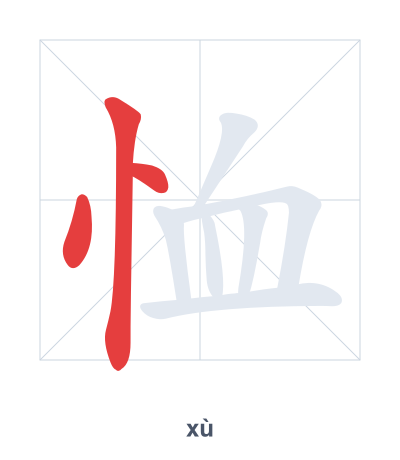
Open Hanzi Writer to see the animated stroke order and practice writing 恤 with real-time feedback.
The character 恤 (xù) is written with 9 strokes. Follow the standard Chinese stroke order: top to bottom, left to right, outside before inside. The radical 忄 is one of its key components.
Practice the correct stroke order with the Hanzi Writer app to see animated stroke-by-stroke guidance with real-time feedback.
恤 means to sympathize.
As an HSK Level 7 character, 恤 is an intermediate-level character.
恤 combines the heart radical (忄) with 血 (xuè, blood), where blood symbolizes life essence and emotional depth. The character suggests that sympathy flows from the heart like blood, representing a genuine, visceral concern for others' suffering.
💡 Memory Tip: Picture a bleeding heart (忄 + 血) — when you sympathize, you feel their pain so deeply it’s as if your own heart is wounded.
老师很体恤学生。
lǎo shī hěn tǐ xù xué shēng
The teacher is very considerate of the students.
政府发放了抚恤金。
zhèng fǔ fā fàng le fǔ xù jīn
The government issued a pension.
我们要怜恤弱者。
wǒ men yào lián xù ruò zhě
We should show compassion for the weak.
Open Hanzi Writer to see the animated stroke order and practice writing 恤 with real-time feedback.
✨ Animated stroke order · Handwriting recognition · HSK-graded practice · Free to use
The left side is 忄, the heart radical, which shows that the character relates to emotions or feelings. The right side is 血, meaning blood, suggesting a deep emotional bond like that between relatives. Together they create the idea of sympathy or compassion, as if feeling another's pain as strongly as a blood connection.