也 (yě) means "also; too" in Chinese. It has 3 strokes with the radical 乚, and is HSK Level 1.
Rated 1.3/5 in difficulty (beginner-friendly).
Harder than 1% of HSK Level 1 characters.
Appears in 3+ common words including 也是 (yě shì), 我也 (wǒ yě), 也好 (yě hǎo).
In the Hanzi Writer app, most learners master 也 within 3 practice attempts using stroke-by-stroke animation.
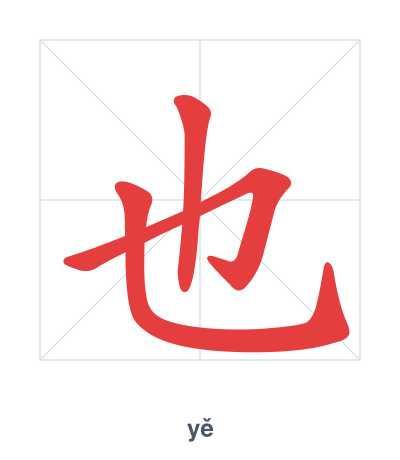
Open Hanzi Writer to see the animated stroke order and practice writing 也 with real-time feedback.
The character 也 (yě) is written with 3 strokes. Follow the standard Chinese stroke order: top to bottom, left to right, outside before inside. The radical 乚 is one of its key components.
Practice the correct stroke order with the Hanzi Writer app to see animated stroke-by-stroke guidance with real-time feedback.
也 means also; too.
As an HSK Level 1 character, 也 is among the first characters beginners learn.
In ancient oracle bone script, 也 depicted a snake with a curved body. It was later borrowed to represent the sound for the adverb 'also' or 'too'.
💡 Memory Tip: Visualize the three strokes of 也 as a snake coiling and hissing 'I also want to come!'
他也是一名汉语老师。
tā yě shì yī míng hàn yǔ lǎo shī
He is also a Chinese teacher.
我也喜欢喝中国茶。
wǒ yě xǐ huān hē zhōng guó chá
I also like drinking Chinese tea.
你不去参加聚会也好。
nǐ bù qù cān jiā jù huì yě hǎo
It's just as well if you don't go to the party.
Open Hanzi Writer to see the animated stroke order and practice writing 也 with real-time feedback.
✨ Animated stroke order · Handwriting recognition · HSK-graded practice · Free to use
也 is a single-component character with no separable parts. Its three strokes form a balanced shape, but the structure does not directly represent the meaning 'also'. The radical 乚 is just a stroke shape, not a clue to the meaning.