腺 (xiàn) means "gland" in Chinese. It has 13 strokes with the radical ⺼, and is HSK Level 7.
Rated 4.2/5 in difficulty (advanced).
Harder than 84% of HSK Level 7 characters.
Appears in 3+ common words including 汗腺 (hàn xiàn), 泪腺 (lèi xiàn), 腺体 (xiàn tǐ).
Due to its 13 strokes, Hanzi Writer's error detection shows 腺 requires focused practice — most learners need 10+ attempts for consistent accuracy.
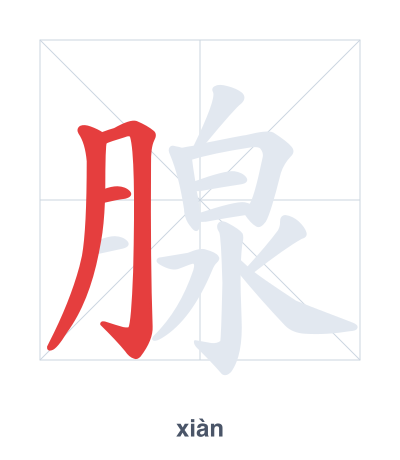
Open Hanzi Writer to see the animated stroke order and practice writing 腺 with real-time feedback.
The character 腺 (xiàn) is written with 13 strokes. Follow the standard Chinese stroke order: top to bottom, left to right, outside before inside. The radical ⺼ is one of its key components.
Practice the correct stroke order with the Hanzi Writer app to see animated stroke-by-stroke guidance with real-time feedback.
腺 means gland.
As an HSK Level 7 character, 腺 is an intermediate-level character.
The character 腺 combines the flesh radical ⺼ (indicating body tissue) with 泉 (quán, meaning 'spring' or 'water source'), depicting a gland as a fleshy spring that secretes fluids. This compound reflects the ancient understanding of glands as organs that release vital liquids, much like a spring in the body.
💡 Memory Tip: Picture a tiny spring (泉) embedded in a piece of meat (⺼) that squirts out a clear fluid—that's your gland.
汗腺可以排汗。
hàn xiàn kě yǐ pái hàn
Sweat glands can discharge sweat.
泪腺产生眼泪。
lèi xiàn chǎn shēng yǎn lèi
The tear glands produce tears.
腺体很重要。
xiàn tǐ hěn zhòng yào
Glands are very important.
Open Hanzi Writer to see the animated stroke order and practice writing 腺 with real-time feedback.
✨ Animated stroke order · Handwriting recognition · HSK-graded practice · Free to use
The character 腺 combines the radical ⺼ (meat/flesh) on the left and 泉 (spring) on the right. This represents a fleshy body part that releases fluid, like a spring. Therefore 腺 means gland, an organ that secretes substances.