痫 (xián) means "epilepsy" in Chinese. It has 12 strokes with the radical 疒.
Rated 4.2/5 in difficulty (advanced).
Appears in 3+ common words including 癫痫 (diān xián), 痫症 (xián zhèng), 痫病 (xián bìng).
Due to its 12 strokes, Hanzi Writer's error detection shows 痫 requires focused practice — most learners need 10+ attempts for consistent accuracy.
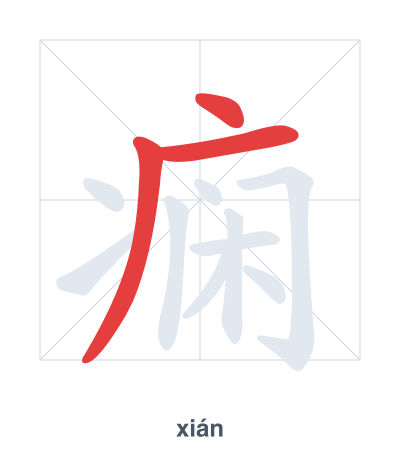
Open Hanzi Writer to see the animated stroke order and practice writing 痫 with real-time feedback.
The character 痫 (xián) is written with 12 strokes. Follow the standard Chinese stroke order: top to bottom, left to right, outside before inside. The radical 疒 is one of its key components.
Practice the correct stroke order with the Hanzi Writer app to see animated stroke-by-stroke guidance with real-time feedback.
痫 means epilepsy.
痫 combines the illness radical 疒 with the phonetic component 闲 (xián, meaning 'idle' or 'leisure'), suggesting a disease that strikes suddenly when the mind is at rest. The original meaning referred to epilepsy, a condition characterized by intermittent seizures.
💡 Memory Tip: Picture a sick person (疒) lying idle (闲) inside a wooden door (门+木), suddenly convulsing from an epileptic fit.
癫痫是一种脑部疾病。
diān xián shì yī zhǒng nǎo bù jí bìng
Epilepsy is a brain disorder.
他患有严重的痫症。
tā huàn yǒu yán zhòng de xián zhèng
He suffers from severe epilepsy.
这种痫病可以预防。
zhè zhǒng xián bìng kě yǐ yù fáng
This type of epilepsy can be prevented.
Open Hanzi Writer to see the animated stroke order and practice writing 痫 with real-time feedback.
✨ Animated stroke order · Handwriting recognition · HSK-graded practice · Free to use
痫 is composed of the radical 疒 (sickness) on the left and the phonetic component 闲 (xián) on the right. The radical indicates that the character relates to illness or disease, while the right side provides a clue to its pronunciation. Together, they form the meaning 'epilepsy,' which is a neurological disorder.