隰 (xí) means "lowland; marsh" in Chinese. It has 16 strokes with the radical 阝.
Rated 3.9/5 in difficulty (challenging).
Appears in 3+ common words including 隰地 (xí dì), 隰草 (xí cǎo), 隰县 (xí xiàn).
Due to its 16 strokes, Hanzi Writer's error detection shows 隰 requires focused practice — most learners need 10+ attempts for consistent accuracy.
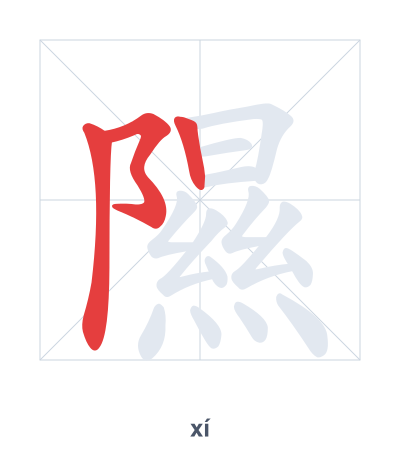
Open Hanzi Writer to see the animated stroke order and practice writing 隰 with real-time feedback.
The character 隰 (xí) is written with 16 strokes. Follow the standard Chinese stroke order: top to bottom, left to right, outside before inside. The radical 阝 is one of its key components.
Practice the correct stroke order with the Hanzi Writer app to see animated stroke-by-stroke guidance with real-time feedback.
隰 means lowland; marsh.
The character 隰 combines the radical 阝 (a hill/mound, from 阜) on the left with 㬎 (xiǎn, meaning 'damp' or 'wet') on the right. Together, they depict a low-lying, wet area between hills—a marsh or lowland. The right component 㬎 itself is formed from 日 (sun) and 丝 (silk), suggesting the sun drying wet silk, reinforcing the idea of moisture in a low place.
💡 Memory Tip: Picture a damp marsh (隰) where the sun (日) glistens on tangled silk-like reeds (丝) between two hills (阝).
隰地里有很多水。
xí dì lǐ yǒu hěn duō shuǐ
There is a lot of water in the marshland.
隰草长得很绿。
xí cǎo zhǎng dé hěn lǜ
The marsh grass grows very green.
他家在隰县。
tā jiā zài xí xiàn
His family is in Xi County.
Open Hanzi Writer to see the animated stroke order and practice writing 隰 with real-time feedback.
✨ Animated stroke order · Handwriting recognition · HSK-graded practice · Free to use
The character 隰 is composed of the left radical 阝 (meaning 'mound' or 'hill') and the right component 㬎. The radical 阝 indicates that the character relates to land or terrain, while the right side hints at moisture or wetness, together suggesting a low, wet area like a marsh.