羲 (xī) means "breath; vapor (often used in mythological names)" in Chinese. It has 16 strokes with the radical 羊.
Rated 4.2/5 in difficulty (advanced).
Appears in 3+ common words including 伏羲 (fú xī), 王羲之 (wáng xī zhī), 羲和 (xī hé).
Due to its 16 strokes, Hanzi Writer's error detection shows 羲 requires focused practice — most learners need 10+ attempts for consistent accuracy.
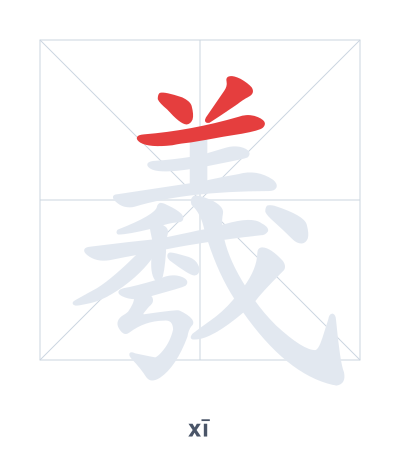
Open Hanzi Writer to see the animated stroke order and practice writing 羲 with real-time feedback.
The character 羲 (xī) is written with 16 strokes. Follow the standard Chinese stroke order: top to bottom, left to right, outside before inside. The radical 羊 is one of its key components.
Practice the correct stroke order with the Hanzi Writer app to see animated stroke-by-stroke guidance with real-time feedback.
羲 means breath; vapor (often used in mythological names).
| Character | 羲 |
| Pinyin | xī (xi) |
| Meaning | breath; vapor (often used in mythological names) |
| Strokes | 16 |
| Radical | 羊 |
| Difficulty | 4.2/5 |
羲 combines a sheep (羊) as a sacrificial offering with 兮 (xī), which depicts a sighing breath. Originally it related to the breath or vapor from a ritual sacrifice, later extended to mean 'breath' or 'vapor' and used in mythological names like Fuxi (伏羲).
💡 Memory Tip: Imagine a sacred sheep (羊) exhaling a mystical breath (兮) that forms the sound 'xi' as it becomes a mythical vapor.
伏羲是神话中的人物。
fú xī shì shén huà zhōng de rén wù
Fu Xi is a mythological figure.
王羲之是著名的书法家。
wáng xī zhī shì zhù míng de shū fǎ jiā
Wang Xizhi is a famous calligrapher.
羲和是传说中的太阳女神。
xī hé shì chuán shuō zhōng de tài yáng nǚ shén
Xihe is the legendary sun goddess.
Open Hanzi Writer to see the animated stroke order and practice writing 羲 with real-time feedback.
✨ Animated stroke order · Handwriting recognition · HSK-graded practice · Free to use
The character 羲 is composed of 羊 (sheep) on top and 兮 (an exclamation or breath sound) below. The radical 羊 gives the character a sense of sacrifice or auspiciousness, while 兮 hints at the meaning of breath or vapor. Together, they form a character often used in ancient mythological names rather than everyday words.