羰 (tāng) means "carbonyl (chemical radical)" in Chinese. It has 15 strokes with the radical 羊.
Rated 4.2/5 in difficulty (advanced).
Appears in 3+ common words including 羰基 (tāng jī), 羰基化 (tāng jī huà), 羰基铁 (tāng jī tiě).
Due to its 15 strokes, Hanzi Writer's error detection shows 羰 requires focused practice — most learners need 10+ attempts for consistent accuracy.
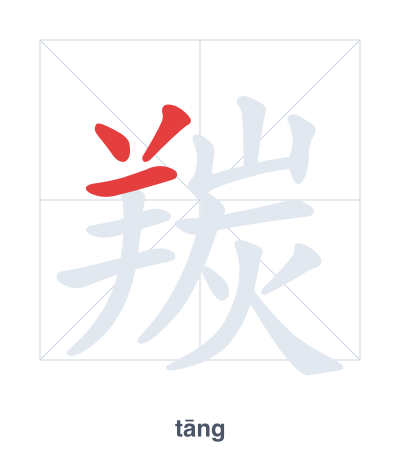
Open Hanzi Writer to see the animated stroke order and practice writing 羰 with real-time feedback.
The character 羰 (tāng) is written with 15 strokes. Follow the standard Chinese stroke order: top to bottom, left to right, outside before inside. The radical 羊 is one of its key components.
Practice the correct stroke order with the Hanzi Writer app to see animated stroke-by-stroke guidance with real-time feedback.
羰 means carbonyl (chemical radical).
| Character | 羰 |
| Pinyin | tāng (tang) |
| Meaning | carbonyl (chemical radical) |
| Strokes | 15 |
| Radical | 羊 |
| Difficulty | 4.2/5 |
羰 is a modern compound character for the chemical carbonyl group, built from the radical 羊 (indicating a 'group' in chemistry) and 炭 (charcoal/carbon), which provides both the phonetic hint (t- from tàn) and the semantic link to carbon. The upper 羊 visually suggests a 'radical' or 'group', while the lower 炭 represents the carbon atom central to the carbonyl structure.
💡 Memory Tip: Picture a sheep (羊) standing on a heap of charcoal (炭), its breath smelling like burnt carbon—that's the carbonyl group.
羰基是化学中的术语。
tāng jī shì huà xué zhōng de shù yǔ
Carbonyl is a term in chemistry.
羰基化反应很重要。
tāng jī huà fǎn yìng hěn zhòng yào
The carbonylation reaction is very important.
这是羰基铁粉。
zhè shì tāng jī tiě fěn
This is carbonyl iron powder.
Open Hanzi Writer to see the animated stroke order and practice writing 羰 with real-time feedback.
✨ Animated stroke order · Handwriting recognition · HSK-graded practice · Free to use
羰 consists of the radical 羊 (sheep) on top and 炭 (charcoal, carbon) below. The bottom 炭 provides the carbon element, while the top 羊 may act as a phonetic hint, though not exact. Together they represent the carbonyl group, a chemical structure containing carbon and oxygen.