羯 (jié) means "wether (castrated ram); Jie (ancient ethnic group)" in Chinese. It has 15 strokes with the radical 羊.
Rated 4.2/5 in difficulty (advanced).
Appears in 3+ common words including 摩羯座 (mó jié zuò), 羯族 (jié zú), 羯鼓 (jié gǔ).
Due to its 15 strokes, Hanzi Writer's error detection shows 羯 requires focused practice — most learners need 10+ attempts for consistent accuracy.
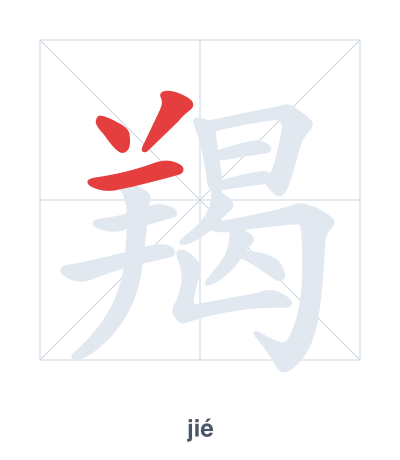
Open Hanzi Writer to see the animated stroke order and practice writing 羯 with real-time feedback.
The character 羯 (jié) is written with 15 strokes. Follow the standard Chinese stroke order: top to bottom, left to right, outside before inside. The radical 羊 is one of its key components.
Practice the correct stroke order with the Hanzi Writer app to see animated stroke-by-stroke guidance with real-time feedback.
羯 means wether (castrated ram); Jie (ancient ethnic group).
| Character | 羯 |
| Pinyin | jié (jie) |
| Meaning | wether (castrated ram); Jie (ancient ethnic group) |
| Strokes | 15 |
| Radical | 羊 |
| Difficulty | 4.2/5 |
羯 is a compound character combining the radical 羊 (sheep) with 曷 (hé) as a phonetic component. It originally referred to a castrated ram, directly linking the sheep radical to the animal. Later it was also used to denote the Jie people, an ancient ethnic group.
💡 Memory Tip: Picture a sheep (羊) with a big X (from 曷) carved into its side to show it's been neutered, making it a wether.
他是摩羯座。
tā shì mó jié zuò
He is a Capricorn.
羯族是古代的一个民族。
jié zú shì gǔ dài de yí gè mín zú
The Jie were an ancient ethnic group.
他在练习打羯鼓。
tā zài liàn xí dǎ jié gǔ
He is practicing playing the Jie drum.
Open Hanzi Writer to see the animated stroke order and practice writing 羯 with real-time feedback.
✨ Animated stroke order · Handwriting recognition · HSK-graded practice · Free to use
The character 羯 is composed of two parts: the left radical 羊 (sheep) and the right component 曷 (hé), which provides the sound. The 羊 radical indicates that the character relates to a sheep or ram, and 羯 specifically refers to a castrated ram. The right side 曷 is phonetic and does not contribute directly to the meaning, but together they form the character used for the Jie people and Capricorn.