喂 (wèi) means "to feed; hello; hey" in Chinese. It has 12 strokes with the radical 口, and is HSK Level 2.
Rated 3.7/5 in difficulty (challenging).
Harder than 71% of HSK Level 2 characters.
Appears in 2+ common words including 喂 (wèi), 喂养 (wèi yǎng).
Due to its 12 strokes, Hanzi Writer's error detection shows 喂 requires focused practice — most learners need 10+ attempts for consistent accuracy.
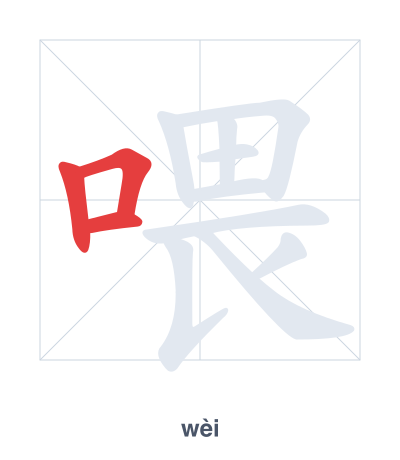
Open Hanzi Writer to see the animated stroke order and practice writing 喂 with real-time feedback.
The character 喂 (wèi) is written with 12 strokes. Follow the standard Chinese stroke order: top to bottom, left to right, outside before inside. The radical 口 is one of its key components.
Practice the correct stroke order with the Hanzi Writer app to see animated stroke-by-stroke guidance with real-time feedback.
喂 means to feed; hello; hey.
As an HSK Level 2 character, 喂 is among the first characters beginners learn.
喂 combines the mouth radical 口 (actions of speaking or eating) with 畏 (wèi, 'to fear' as a phonetic component). The original meaning 'to feed' arises from the mouth putting food into another's mouth. The interjection meanings ('hello'/'hey') come from using the mouth to call out loudly, as if to get someone's fearful attention.
💡 Memory Tip: Picture feeding a scared 'wei' (畏) baby by opening your mouth (口) wide and saying 'Hey! Open up!'
喂,请问你是哪位?
wèi qǐng wèn nǐ shì nǎ wèi
Hello, who is this, please?
喂,快点儿过来!
wèi kuài diǎn ér guò lái
Hey, come over here quickly!
他在喂养小猫。
tā zài wèi yǎng xiǎo māo
He is feeding a kitten.
Open Hanzi Writer to see the animated stroke order and practice writing 喂 with real-time feedback.
✨ Animated stroke order · Handwriting recognition · HSK-graded practice · Free to use
喂 is made of the radical 口 (mouth) on the left and 畏 (wèi, meaning 'fear') on the right. The mouth radical relates to actions like feeding or speaking, while 畏 originally provided the sound. The character's meanings—'to feed' and 'hello/hey'—both involve using the mouth.