违 (wéi) means "to violate / to go against" in Chinese. It has 7 strokes with the radical 辶, and is HSK Level 5.
Rated 3.5/5 in difficulty (challenging).
Harder than 29% of HSK Level 5 characters.
Appears in 3+ common words including 违反 (wéi fǎn), 违约 (wéi yuē), 违背 (wéi bèi).
Due to its 7 strokes, Hanzi Writer's error detection shows 违 requires focused practice — most learners need 10+ attempts for consistent accuracy.
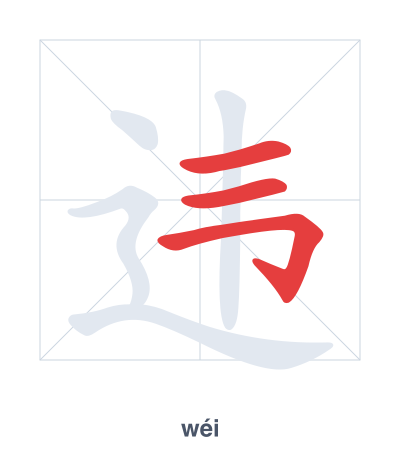
Open Hanzi Writer to see the animated stroke order and practice writing 违 with real-time feedback.
The character 违 (wéi) is written with 7 strokes. Follow the standard Chinese stroke order: top to bottom, left to right, outside before inside. The radical 辶 is one of its key components.
Practice the correct stroke order with the Hanzi Writer app to see animated stroke-by-stroke guidance with real-time feedback.
违 means to violate / to go against.
As an HSK Level 5 character, 违 is an intermediate-level character.
The character 违 combines the radical 辶 (walking) with 韦, which originally depicted a foot turning around to go the opposite direction, together meaning to go against or violate.
💡 Memory Tip: Picture someone walking (辶) but suddenly turning around (韦 resembles a U-turn) — they are violating the expected direction.
不要违反交通规则。
bú yào wéi fǎn jiāo tōng guī zé
Don't violate traffic rules.
如果违约,要赔偿损失。
rú guǒ wéi yuē yào péi cháng sǔn shī
If the contract is breached, compensation for losses must be paid.
他违背了自己的诺言。
tā wéi bèi le zì jǐ de nuò yán
He broke his promise.
Open Hanzi Writer to see the animated stroke order and practice writing 违 with real-time feedback.
✨ Animated stroke order · Handwriting recognition · HSK-graded practice · Free to use
The character 违 consists of the radical 辶 (walk) on the outside and 韦 (wéi, a phonetic component) inside. The radical 辶 suggests movement or action, which connects to the idea of going against or violating something. The phonetic part 韦 hints at the pronunciation but does not directly contribute to the meaning.