戒 (jiè) means "To quit (a habit)" in Chinese. It has 7 strokes with the radical 戈, and is HSK Level 5.
Rated 3.5/5 in difficulty (challenging).
Harder than 24% of HSK Level 5 characters.
Appears in 3+ common words including 戒指 (jiè zhǐ), 戒烟 (jiè yān), 戒备 (jiè bèi).
Due to its 7 strokes, Hanzi Writer's error detection shows 戒 requires focused practice — most learners need 10+ attempts for consistent accuracy.
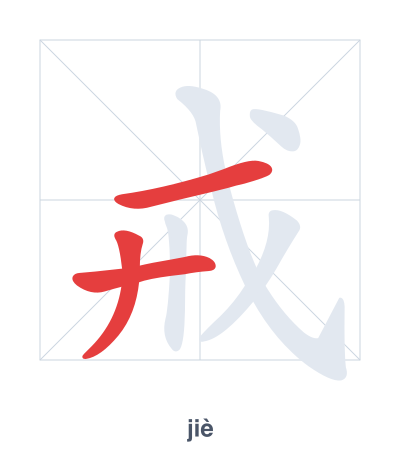
Open Hanzi Writer to see the animated stroke order and practice writing 戒 with real-time feedback.
The character 戒 (jiè) is written with 7 strokes. Follow the standard Chinese stroke order: top to bottom, left to right, outside before inside. The radical 戈 is one of its key components.
Practice the correct stroke order with the Hanzi Writer app to see animated stroke-by-stroke guidance with real-time feedback.
戒 means To quit (a habit).
As an HSK Level 5 character, 戒 is an intermediate-level character.
戒 combines 戈 (dagger-axe, representing a weapon) and 廾 (two hands), showing hands holding a weapon to guard against danger. This originally meant 'to warn' or 'to be on guard,' and later extended to 'to quit' a habit as a form of self-protection.
💡 Memory Tip: Picture two hands (廾) raising a dagger (戈) to cut off a bad habit once and for all.
这是一个金戒指。
zhè shì yí gè jīn jiè zhǐ
This is a gold ring.
他决定戒烟了。
tā jué dìng jiè yān le
He decided to quit smoking.
这里的戒备很严。
zhè lǐ de jiè bèi hěn yán
The security here is very tight.
Open Hanzi Writer to see the animated stroke order and practice writing 戒 with real-time feedback.
✨ Animated stroke order · Handwriting recognition · HSK-graded practice · Free to use
戒 is made of two parts: the left side is 戈 (a spear or weapon) and the right side is 廾 (two hands). Together, they show hands holding a weapon to stay on guard, which connects to the meaning of being alert (戒备) and later to quitting a habit as a form of self-discipline.