蛙 (wā) means "frog" in Chinese. It has 12 strokes with the radical 虫, and is HSK Level 7.
Rated 4.2/5 in difficulty (advanced).
Harder than 88% of HSK Level 7 characters.
Appears in 3+ common words including 青蛙 (qīng wā), 蛙泳 (wā yǒng), 牛蛙 (niú wā).
Due to its 12 strokes, Hanzi Writer's error detection shows 蛙 requires focused practice — most learners need 10+ attempts for consistent accuracy.
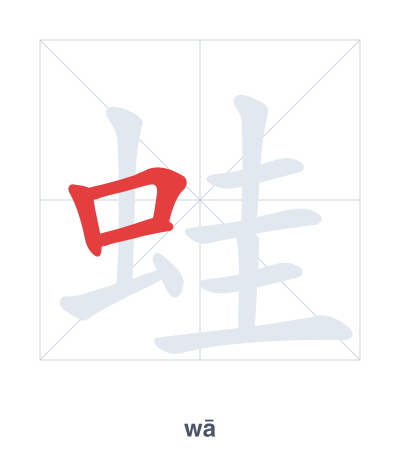
Open Hanzi Writer to see the animated stroke order and practice writing 蛙 with real-time feedback.
The character 蛙 (wā) is written with 12 strokes. Follow the standard Chinese stroke order: top to bottom, left to right, outside before inside. The radical 虫 is one of its key components.
Practice the correct stroke order with the Hanzi Writer app to see animated stroke-by-stroke guidance with real-time feedback.
蛙 means frog.
As an HSK Level 7 character, 蛙 is an intermediate-level character.
蛙 is a phono-semantic compound where the radical 虫 (insect/animal) indicates it's a creature, and 圭 (guī, a pointed jade tablet) provides the pronunciation wā. The original character may have depicted a frog's shape, but today it combines the animal radical with a phonetic hint.
💡 Memory Tip: Imagine a frog sitting on a jade tablet (圭) made of two earth mounds, surrounded by bugs (虫).
池塘里有很多青蛙。
chí táng lǐ yǒu hěn duō qīng wā
There are many frogs in the pond.
我最擅长游蛙泳。
wǒ zuì shàn cháng yóu wā yǒng
I am best at breaststroke.
晚餐我们吃了牛蛙。
wǎn cān wǒ men chī le niú wā
We had bullfrog for dinner.
Open Hanzi Writer to see the animated stroke order and practice writing 蛙 with real-time feedback.
✨ Animated stroke order · Handwriting recognition · HSK-graded practice · Free to use
蛙 contains the radical 虫 (insect) on the left and the phonetic component 圭 (guī) on the right. The radical connects the character to small creatures, while 圭 provides a hint to the pronunciation wā. Together they form the word for 'frog.'