蚌 (bàng) means "Mussel / Clam" in Chinese. It has 10 strokes with the radical 虫.
Rated 4.2/5 in difficulty (advanced).
Appears in 3+ common words including 蚌壳 (bàng ké), 珍珠蚌 (zhēn zhū bàng), 蚌肉 (bàng ròu).
Due to its 10 strokes, Hanzi Writer's error detection shows 蚌 requires focused practice — most learners need 10+ attempts for consistent accuracy.
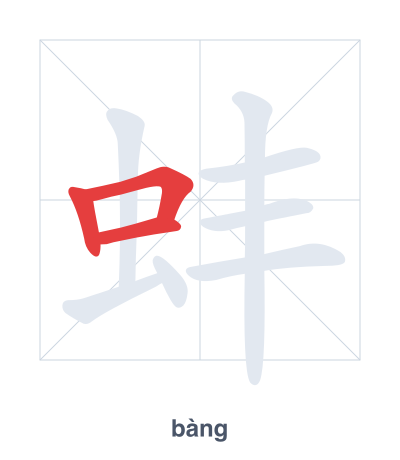
Open Hanzi Writer to see the animated stroke order and practice writing 蚌 with real-time feedback.
The character 蚌 (bàng) is written with 10 strokes. Follow the standard Chinese stroke order: top to bottom, left to right, outside before inside. The radical 虫 is one of its key components.
Practice the correct stroke order with the Hanzi Writer app to see animated stroke-by-stroke guidance with real-time feedback.
蚌 means Mussel / Clam.
蚌 is a phono-semantic compound: the radical 虫 (insect/creature) indicates it is a kind of aquatic animal, while 丰 (fēng) originally meant 'lush' or 'abundant' and here provides a phonetic hint (the pronunciation shifted to bàng).
💡 Memory Tip: Imagine a clam with a shell pattern that looks like the character 丰, sitting on a squiggly creature 虫 — it's a 'bàng' clam showing off its abundant ridges.
这里的蚌壳很漂亮。
zhè lǐ de bàng ké hěn piào liàng
The shells here are very beautiful.
珍珠蚌里有珍珠。
zhēn zhū bàng lǐ yǒu zhēn zhū
There are pearls inside pearl oysters.
蚌肉的味道很好。
bàng ròu de wèi dào hěn hǎo
Clam meat tastes very good.
Open Hanzi Writer to see the animated stroke order and practice writing 蚌 with real-time feedback.
✨ Animated stroke order · Handwriting recognition · HSK-graded practice · Free to use
蚌 is made of two parts: the left radical 虫 (meaning insect or creature) and the right component 丰. The radical 虫 shows that 蚌 is a type of animal, specifically a shellfish. The right part 丰 gives a loose hint about the character's pronunciation bàng.