屠 (tú) means "to slaughter; to butcher" in Chinese. It has 11 strokes with the radical 尸, and is HSK Level 7.
Rated 4.2/5 in difficulty (advanced).
Harder than 53% of HSK Level 7 characters.
Appears in 3+ common words including 屠夫 (tú fū), 屠宰 (tú zǎi), 屠杀 (tú shā).
Due to its 11 strokes, Hanzi Writer's error detection shows 屠 requires focused practice — most learners need 10+ attempts for consistent accuracy.
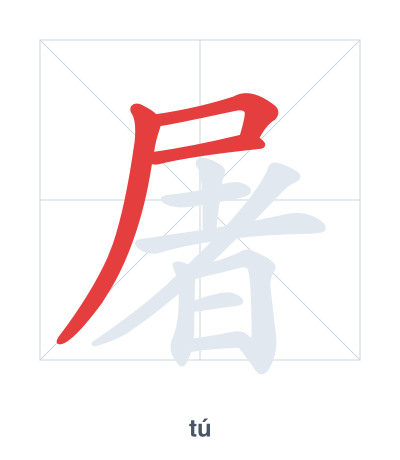
Open Hanzi Writer to see the animated stroke order and practice writing 屠 with real-time feedback.
The character 屠 (tú) is written with 11 strokes. Follow the standard Chinese stroke order: top to bottom, left to right, outside before inside. The radical 尸 is one of its key components.
Practice the correct stroke order with the Hanzi Writer app to see animated stroke-by-stroke guidance with real-time feedback.
屠 means to slaughter; to butcher.
As an HSK Level 7 character, 屠 is an intermediate-level character.
屠 combines a corpse (尸) with the phonetic component 者 (ancient pronunciation similar to tú), visually representing the act of slaughter that leaves a dead body. The left radical 尸 emphasizes the fatal outcome, while the right part 者 indicates the sound and can also be interpreted as a person involved in butchery.
💡 Memory Tip: Picture a butcher (者) standing over a corpse (尸) with a cleaver, ready to slaughter.
那个屠夫在干活。
nà ge tú fū zài gàn huó
That butcher is working.
这里是屠宰场。
zhè lǐ shì tú zǎi chǎng
This is a slaughterhouse.
我们反对屠杀。
wǒ men fǎn duì tú shā
We oppose massacre.
Open Hanzi Writer to see the animated stroke order and practice writing 屠 with real-time feedback.
✨ Animated stroke order · Handwriting recognition · HSK-graded practice · Free to use
屠 is composed of the radical 尸 (corpse or body) on the left and 者 (person) on the right. The radical 尸 suggests a dead body involved in butchery, while 者 indicates the person performing the action. Together they represent a person (者) working with a dead body (尸) — that is, a butcher or slaughterer.