屎 (shǐ) means "Excrement; poop." in Chinese. It has 9 strokes with the radical 尸.
Rated 4/5 in difficulty (challenging).
Appears in 3+ common words including 拉屎 (lā shǐ), 鸟屎 (niǎo shǐ), 眼屎 (yǎn shǐ).
Due to its 9 strokes, Hanzi Writer's error detection shows 屎 requires focused practice — most learners need 10+ attempts for consistent accuracy.
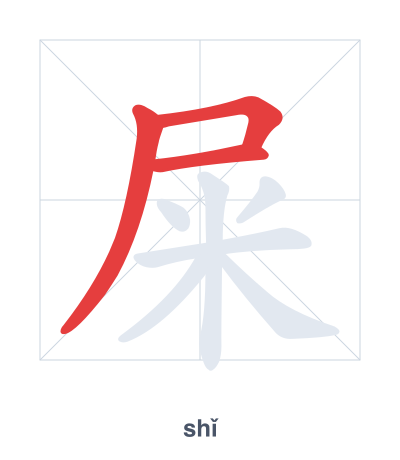
Open Hanzi Writer to see the animated stroke order and practice writing 屎 with real-time feedback.
The character 屎 (shǐ) is written with 9 strokes. Follow the standard Chinese stroke order: top to bottom, left to right, outside before inside. The radical 尸 is one of its key components.
Practice the correct stroke order with the Hanzi Writer app to see animated stroke-by-stroke guidance with real-time feedback.
屎 means Excrement; poop..
The character 屎 combines the radical 尸 (corpse, representing the body or a person) with 米 (rice), symbolizing undigested food. Together, they depict waste from the body, specifically excrement.
💡 Memory Tip: Imagine a corpse (尸) lying on the ground, with rice grains (米) spilling out from beneath it as stinking poop.
小狗在草地上拉屎。
xiǎo gǒu zài cǎo dì shàng lā shǐ
The puppy is pooping on the grass.
我的车上有鸟屎。
wǒ de chē shàng yǒu niǎo shǐ
There is bird poop on my car.
他早上起来有很多眼屎。
tā zǎo shàng qǐ lái yǒu hěn duō yǎn shǐ
He has a lot of eye crust when he wakes up in the morning.
Open Hanzi Writer to see the animated stroke order and practice writing 屎 with real-time feedback.
✨ Animated stroke order · Handwriting recognition · HSK-graded practice · Free to use
The character 屎 is made of the radical 尸 (corpse or body) on top and 米 (rice) below. The body radical suggests something related to the body, and rice represents food, so together they show the result of food processing in the body — excrement.