挺 (tǐng) means "very; quite; straight; to stick out" in Chinese. It has 9 strokes with the radical 扌, and is HSK Level 2.
Rated 3.5/5 in difficulty (challenging).
Harder than 63% of HSK Level 2 characters.
Appears in 3+ common words including 挺好 (tǐng hǎo), 挺拔 (tǐng bá), 挺身而出 (tǐng shēn ér chū).
Due to its 9 strokes, Hanzi Writer's error detection shows 挺 requires focused practice — most learners need 10+ attempts for consistent accuracy.
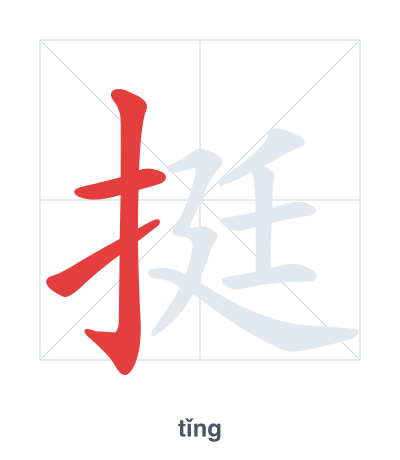
Open Hanzi Writer to see the animated stroke order and practice writing 挺 with real-time feedback.
The character 挺 (tǐng) is written with 9 strokes. Follow the standard Chinese stroke order: top to bottom, left to right, outside before inside. The radical 扌 is one of its key components.
Practice the correct stroke order with the Hanzi Writer app to see animated stroke-by-stroke guidance with real-time feedback.
挺 means very; quite; straight; to stick out.
As an HSK Level 2 character, 挺 is among the first characters beginners learn.
It combines the hand radical 扌 (hand) with 廷 (tǐng, court) as a phonetic component. The hand suggests an action of making something straight or sticking out, as in using one's hand to straighten an object.
💡 Memory Tip: Imagine a hand (扌) straightening a court official (廷) to stand very straight and stick out his chest.
今天的气温挺好的。
jīn tiān de qì wēn tǐng hǎo de
Today's temperature is quite good.
这里的松树很挺拔。
zhè lǐ de sōng shù hěn tǐng bá
The pine trees here are tall and straight.
他在危险时挺身而出。
tā zài wēi xiǎn shí tǐng shēn ér chū
He stepped forward in the face of danger.
Open Hanzi Writer to see the animated stroke order and practice writing 挺 with real-time feedback.
✨ Animated stroke order · Handwriting recognition · HSK-graded practice · Free to use
挺 combines the hand radical 扌 on the left with 廷 (tíng) on the right. 扌 relates to hand actions like pushing or sticking out, while 廷 provides the pronunciation and suggests stretching straight, like a court official standing tall.