啕 (táo) means "To wail; to cry loudly" in Chinese. It has 11 strokes with the radical 口.
Rated 4.2/5 in difficulty (advanced).
Appears in 3+ common words including 号啕大哭 (háo táo dà kū), 啕啕 (táo táo), 啕气 (táo qì).
Due to its 11 strokes, Hanzi Writer's error detection shows 啕 requires focused practice — most learners need 10+ attempts for consistent accuracy.
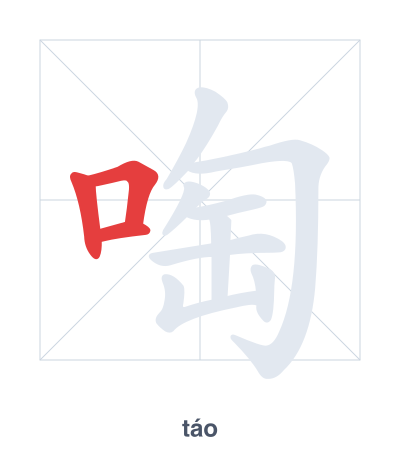
Open Hanzi Writer to see the animated stroke order and practice writing 啕 with real-time feedback.
The character 啕 (táo) is written with 11 strokes. Follow the standard Chinese stroke order: top to bottom, left to right, outside before inside. The radical 口 is one of its key components.
Practice the correct stroke order with the Hanzi Writer app to see animated stroke-by-stroke guidance with real-time feedback.
啕 means To wail; to cry loudly.
啕 is a phono-semantic compound where 口 (mouth) indicates the action of crying out, and 匋 (táo) provides the pronunciation. The character visually depicts a mouth emitting a loud wail, with the phonetic component reinforcing the sound.
💡 Memory Tip: Picture a giant mouth (口) wailing so loudly that it shatters a pottery jar (匋) with its cries.
那个孩子号啕大哭。
nà ge hái zi háo táo dà kū
That child wailed loudly.
他哭得啕啕的。
tā kū dé táo táo de
He cried loudly.
他在家里生啕气。
tā zài jiā lǐ shēng táo qì
He is throwing a tantrum at home.
Open Hanzi Writer to see the animated stroke order and practice writing 啕 with real-time feedback.
✨ Animated stroke order · Handwriting recognition · HSK-graded practice · Free to use
啕 is composed of the radical 口 (mouth) on the left and the phonetic component 匋 on the right. Since crying loudly involves the mouth, the radical directly connects to the meaning of wailing. The right part 匋 provides the pronunciation táo.