哭 (kū) means "To cry" in Chinese. It has 10 strokes with the radical 口, and is HSK Level 2.
Rated 3.7/5 in difficulty (challenging).
Harder than 70% of HSK Level 2 characters.
Appears in 3+ common words including 别哭 (bié kū), 大哭 (dà kū), 哭了 (kū le).
Due to its 10 strokes, Hanzi Writer's error detection shows 哭 requires focused practice — most learners need 10+ attempts for consistent accuracy.
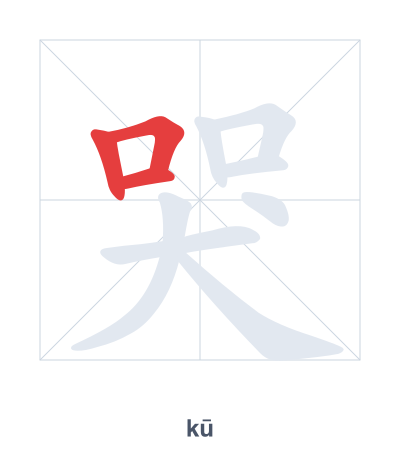
Open Hanzi Writer to see the animated stroke order and practice writing 哭 with real-time feedback.
The character 哭 (kū) is written with 10 strokes. Follow the standard Chinese stroke order: top to bottom, left to right, outside before inside. The radical 口 is one of its key components.
Practice the correct stroke order with the Hanzi Writer app to see animated stroke-by-stroke guidance with real-time feedback.
哭 means To cry.
As an HSK Level 2 character, 哭 is among the first characters beginners learn.
The character 哭 combines two 口 (mouth) radicals and 犬 (dog), depicting a dog howling or barking in distress, which visually resembles a person crying.
💡 Memory Tip: Picture a dog (犬) with two wide-open mouths (口口) wailing loudly as if crying.
别哭了,笑一下。
bié kū le xiào yī xià
Stop crying and give me a smile.
那个孩子在大哭。
nà ge hái zi zài dà kū
That child is crying loudly.
她难过得哭了。
tā nán guò dé kū le
She was so sad that she cried.
Open Hanzi Writer to see the animated stroke order and practice writing 哭 with real-time feedback.
✨ Animated stroke order · Handwriting recognition · HSK-graded practice · Free to use
哭 combines two 口 (mouth) radicals on top and 犬 (dog) below. The two mouths suggest loud, open-mouthed crying, while the dog component hints at the howling sound of a dog, reinforcing the idea of crying.