螳 (táng) means "mantis" in Chinese. It has 17 strokes with the radical 虫.
Rated 4.2/5 in difficulty (advanced).
Appears in 3+ common words including 螳螂 (táng láng), 螳臂 (táng bì), 螳螂拳 (táng láng quán).
Due to its 17 strokes, Hanzi Writer's error detection shows 螳 requires focused practice — most learners need 10+ attempts for consistent accuracy.
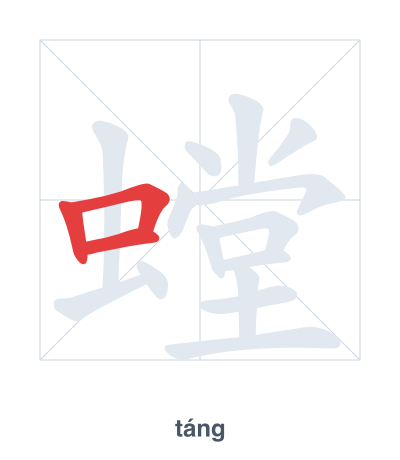
Open Hanzi Writer to see the animated stroke order and practice writing 螳 with real-time feedback.
The character 螳 (táng) is written with 17 strokes. Follow the standard Chinese stroke order: top to bottom, left to right, outside before inside. The radical 虫 is one of its key components.
Practice the correct stroke order with the Hanzi Writer app to see animated stroke-by-stroke guidance with real-time feedback.
螳 means mantis.
螳 is a phono-semantic compound combining the radical 虫 (insect) with the phonetic component 堂 (táng, meaning 'hall'), indicating that the mantis is an insect associated with the sound 'táng'. The character visually represents a type of insect through its radical, while the phonetic part provides pronunciation and no direct meaning connection to the mantis itself.
💡 Memory Tip: Picture a mantis (虫) performing a martial arts stance in a grand hall (堂), ready to strike like a praying mantis.
螳螂在捕食。
táng láng zài bǔ shí
The mantis is hunting.
别做螳臂当车的事。
bié zuò táng bì dāng chē de shì
Don't overrate yourself and try to stop an overwhelming force.
他在学螳螂拳。
tā zài xué táng láng quán
He is learning Praying Mantis Boxing.
Open Hanzi Writer to see the animated stroke order and practice writing 螳 with real-time feedback.
✨ Animated stroke order · Handwriting recognition · HSK-graded practice · Free to use
螳 is made of two parts: the left radical 虫 (insect) and the right part 唐 (táng) which gives the sound. The 虫 radical shows that 螳 is a type of insect, specifically a mantis. The right side is purely phonetic and does not add meaning.