眭 (suī) means "to look with a side glance; a surname" in Chinese. It has 11 strokes with the radical 目.
Rated 4.2/5 in difficulty (advanced).
Appears in 3+ common words including 姓眭 (xìng suī), 眭目 (suī mù), 眭然 (suī rán).
Due to its 11 strokes, Hanzi Writer's error detection shows 眭 requires focused practice — most learners need 10+ attempts for consistent accuracy.
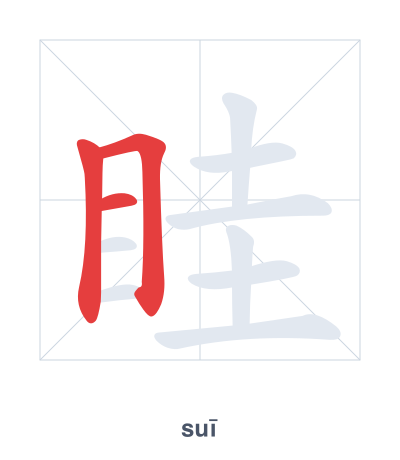
Open Hanzi Writer to see the animated stroke order and practice writing 眭 with real-time feedback.
The character 眭 (suī) is written with 11 strokes. Follow the standard Chinese stroke order: top to bottom, left to right, outside before inside. The radical 目 is one of its key components.
Practice the correct stroke order with the Hanzi Writer app to see animated stroke-by-stroke guidance with real-time feedback.
眭 means to look with a side glance; a surname.
眭 is a phono-semantic compound: the radical 目 (eye) indicates that the meaning relates to seeing, while the component 圭 (guì, a jade tablet) provides the pronunciation. The specific sense of 'to look with a side glance' likely comes from the eye radical, suggesting a sideways or squinting look.
💡 Memory Tip: Picture an eye (目) slyly side-glancing at a valuable jade tablet (圭) someone is holding nearby.
我的老师姓眭。
wǒ de lǎo shī xìng suī
My teacher's surname is Sui.
他眭目看着我。
tā suī mù kàn zhe wǒ
He looked at me with wide eyes.
他眭然一笑。
tā suī rán yī xiào
He gave a slight smile.
Open Hanzi Writer to see the animated stroke order and practice writing 眭 with real-time feedback.
✨ Animated stroke order · Handwriting recognition · HSK-graded practice · Free to use
眭 is made of the radical 目 (eye) on the left and the phonetic component 圭 (guī) on the right. The eye radical hints that the character involves looking or staring, while 圭 provides the sound suī. Together, the structure conveys the idea of looking sideways or staring with the eyes.