眦 (zì) means "corner of the eye" in Chinese. It has 11 strokes with the radical 目.
Rated 4.2/5 in difficulty (advanced).
Appears in 3+ common words including 睚眦 (yá zì), 眦裂 (zì liè), 眦目 (zì mù).
Due to its 11 strokes, Hanzi Writer's error detection shows 眦 requires focused practice — most learners need 10+ attempts for consistent accuracy.
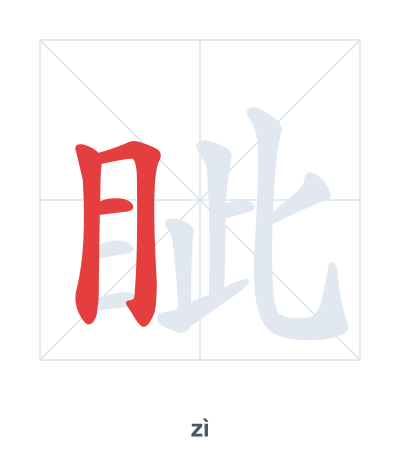
Open Hanzi Writer to see the animated stroke order and practice writing 眦 with real-time feedback.
The character 眦 (zì) is written with 11 strokes. Follow the standard Chinese stroke order: top to bottom, left to right, outside before inside. The radical 目 is one of its key components.
Practice the correct stroke order with the Hanzi Writer app to see animated stroke-by-stroke guidance with real-time feedback.
眦 means corner of the eye.
眦 is a phono-semantic compound: the left radical 目 (eye) indicates the meaning, while the right component 此 (cǐ, meaning 'this') acts as a phonetic hint for the pronunciation zì. The character specifically refers to the corner of the eye, where the eyelids meet.
💡 Memory Tip: Imagine a tiny 'this' (此) sticker stuck right in the corner of your eye (目), making you squint at that spot.
他为人睚眦必报。
tā wéi rén yá zì bì bào
He is the type to seek revenge for even the smallest slight.
他气得目眦尽裂。
tā qì dé mù zì jìn liè
He was so angry that his eyes nearly burst from their sockets.
他眦目而视。
tā zì mù ér shì
He glared with wide eyes.
Open Hanzi Writer to see the animated stroke order and practice writing 眦 with real-time feedback.
✨ Animated stroke order · Handwriting recognition · HSK-graded practice · Free to use
眦 is composed of the radical 目 (eye) on the left and 此 (this) on the right. The eye radical directly points to the eye area, and the character specifically refers to the corner of the eye. The right part 此 provides a phonetic hint, though the meaning comes from the combination of an eye and a position marker.