署 (shǔ) means "Office; bureau; to sign" in Chinese. It has 13 strokes with the radical 罒, and is HSK Level 7.
Rated 4.2/5 in difficulty (advanced).
Harder than 81% of HSK Level 7 characters.
Appears in 3+ common words including 签署 (qiān shǔ), 署名 (shǔ míng), 官署 (guān shǔ).
Due to its 13 strokes, Hanzi Writer's error detection shows 署 requires focused practice — most learners need 10+ attempts for consistent accuracy.
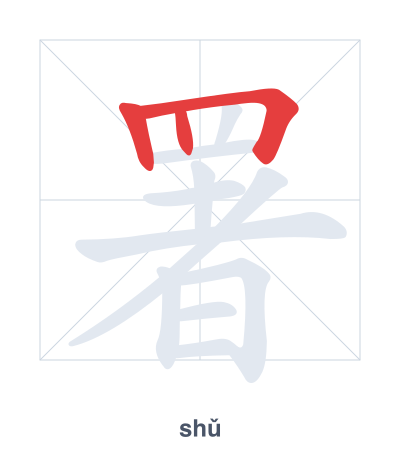
Open Hanzi Writer to see the animated stroke order and practice writing 署 with real-time feedback.
The character 署 (shǔ) is written with 13 strokes. Follow the standard Chinese stroke order: top to bottom, left to right, outside before inside. The radical 罒 is one of its key components.
Practice the correct stroke order with the Hanzi Writer app to see animated stroke-by-stroke guidance with real-time feedback.
署 means Office; bureau; to sign.
As an HSK Level 7 character, 署 is an intermediate-level character.
署 combines 罒 (a net, symbolizing catching/arranging) with 者 (person/thing). Originally meaning 'to arrange' or 'to place,' it later came to refer to an office or bureau where officials arrange affairs, and the meaning 'to sign' derives from affixing one's name to documents in such an official setting.
💡 Memory Tip: Picture a net (罒) draped over a person (者) at a desk, signing papers in a busy office.
请在这里签署名字。
qǐng zài zhè lǐ qiān shǔ míng zì
Please sign your name here.
这封信没有署名。
zhè fēng xìn méi yǒu shǔ míng
This letter is unsigned.
这是一个政府官署。
zhè shì yí gè zhèng fǔ guān shǔ
This is a government office.
Open Hanzi Writer to see the animated stroke order and practice writing 署 with real-time feedback.
✨ Animated stroke order · Handwriting recognition · HSK-graded practice · Free to use
The character 署 has two main parts: the radical 罒 (a net) on top and 者 (person/thing) below. The net radical hints at official authority or control, while 者 represents a person or entity, together forming the idea of a government office or bureau where officials sign documents.