赎 (shú) means "to redeem; to ransom" in Chinese. It has 12 strokes with the radical 贝, and is HSK Level 7.
Rated 4.2/5 in difficulty (advanced).
Harder than 91% of HSK Level 7 characters.
Appears in 3+ common words including 赎回 (shú huí), 赎罪 (shú zuì), 赎身 (shú shēn).
Due to its 12 strokes, Hanzi Writer's error detection shows 赎 requires focused practice — most learners need 10+ attempts for consistent accuracy.
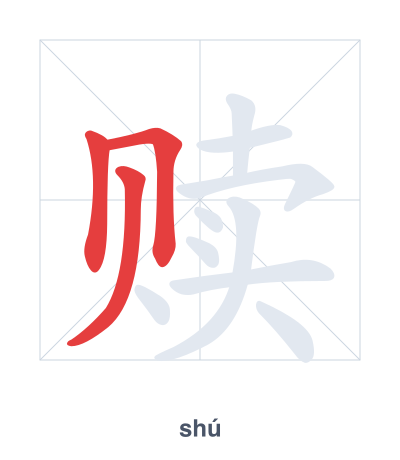
Open Hanzi Writer to see the animated stroke order and practice writing 赎 with real-time feedback.
The character 赎 (shú) is written with 12 strokes. Follow the standard Chinese stroke order: top to bottom, left to right, outside before inside. The radical 贝 is one of its key components.
Practice the correct stroke order with the Hanzi Writer app to see animated stroke-by-stroke guidance with real-time feedback.
赎 means to redeem; to ransom.
As an HSK Level 7 character, 赎 is an intermediate-level character.
赎 is a phono-semantic compound. The radical 贝 (shell, money) indicates its financial meaning, while the component 卖 (to sell) provides a phonetic clue and suggests the transaction of buying back something. Together, they depict the act of using money to ransom or redeem an item or person.
💡 Memory Tip: To redeem (赎) your lost treasure, you must sell (卖) your shells (贝) to get the ransom money.
他想赎回那块表。
tā xiǎng shú huí nà kuài biǎo
He wants to redeem that watch.
他在努力赎罪。
tā zài nǔ lì shú zuì
He is trying hard to atone for his sins.
她终于赎身了。
tā zhōng yú shú shēn le
She finally bought her freedom.
Open Hanzi Writer to see the animated stroke order and practice writing 赎 with real-time feedback.
✨ Animated stroke order · Handwriting recognition · HSK-graded practice · Free to use
赎 is formed from the radical 贝 (shell/money) on the left and the component 卖 (to sell) on the right. The combination suggests using money to "buy back" something, which directly relates to its meanings of redeeming or ransoming. This structure shows that redemption is a financial or exchange-based action.