输 (shū) means "To lose; to transport; to input." in Chinese. It has 13 strokes with the radical 车, and is HSK Level 3.
Rated 4.2/5 in difficulty (advanced).
Harder than 97% of HSK Level 3 characters.
Appears in 3+ common words including 输入 (shū rù), 输赢 (shū yíng), 运输 (yùn shū).
Due to its 13 strokes, Hanzi Writer's error detection shows 输 requires focused practice — most learners need 10+ attempts for consistent accuracy.
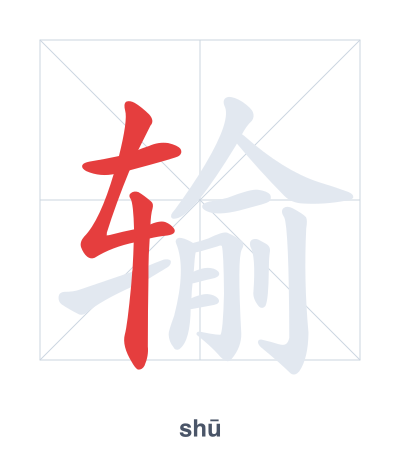
Open Hanzi Writer to see the animated stroke order and practice writing 输 with real-time feedback.
The character 输 (shū) is written with 13 strokes. Follow the standard Chinese stroke order: top to bottom, left to right, outside before inside. The radical 车 is one of its key components.
Practice the correct stroke order with the Hanzi Writer app to see animated stroke-by-stroke guidance with real-time feedback.
输 means To lose; to transport; to input..
As an HSK Level 3 character, 输 is an intermediate-level character.
输 combines the radical 车 (vehicle/chariot) with 俞, a phonetic component that also hints at 'transporting by boat'. Originally meaning 'to transport', it later extended to 'to lose' (as in losing goods in transit) and 'to input'.
💡 Memory Tip: Imagine a race car (车) that spins out of control (the right part 俞 looks like a skid mark) and loses the race.
请输入你的名字。
qǐng shū rù nǐ de míng zì
Please enter your name.
我们不看重输赢。
wǒ men bù kàn zhòng shū yíng
We don't care much about winning or losing.
运输速度很快。
yùn shū sù dù hěn kuài
The shipping speed is very fast.
Open Hanzi Writer to see the animated stroke order and practice writing 输 with real-time feedback.
✨ Animated stroke order · Handwriting recognition · HSK-graded practice · Free to use
输 has the radical 车 (vehicle) on the left and the component 俞 (yú) on the right. The left side hints at transportation, while the right side adds sound and meaning related to movement or loss. Together they create the meanings "to transport," "to input," and "to lose."