示 (shì) means "to show; to indicate" in Chinese. It has 5 strokes with the radical 示, and is HSK Level 3.
Rated 2.3/5 in difficulty (moderate).
Harder than 3% of HSK Level 3 characters.
Appears in 3+ common words including 表示 (biǎo shì), 出示 (chū shì), 指示 (zhǐ shì).
Hanzi Writer's stroke validation shows learners typically need 5-8 attempts to write 示 with correct proportion and order.
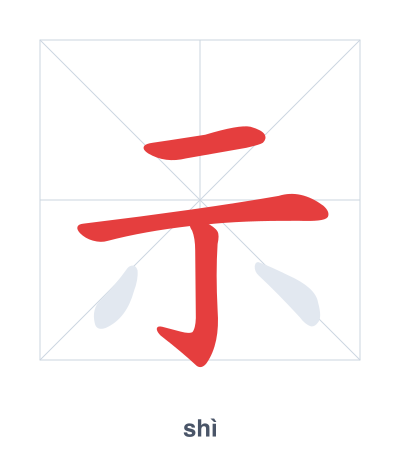
Open Hanzi Writer to see the animated stroke order and practice writing 示 with real-time feedback.
The character 示 (shì) is written with 5 strokes. Follow the standard Chinese stroke order: top to bottom, left to right, outside before inside. The radical 示 is one of its key components.
Practice the correct stroke order with the Hanzi Writer app to see animated stroke-by-stroke guidance with real-time feedback.
示 means to show; to indicate.
As an HSK Level 3 character, 示 is an intermediate-level character.
示 originally depicted an altar or a stone tablet used for sacrificial offerings, with the horizontal top representing the table surface and the vertical and downward strokes symbolizing the legs or the display of offerings. This visual of showing offerings to the gods led to its meanings 'to show' and 'to indicate'.
💡 Memory Tip: Picture the top horizontal line as a table, the vertical line as its stand, and the two dots as offerings placed on it to show to the heavens.
他表示同意我的看法。
tā biǎo shì tóng yì wǒ de kàn fǎ
He expressed agreement with my view.
请出示您的护照。
qǐng chū shì nín de hù zhào
Please show your passport.
请听从老师的指示。
qǐng tīng cóng lǎo shī de zhǐ shì
Please follow the teacher's instructions.
Open Hanzi Writer to see the animated stroke order and practice writing 示 with real-time feedback.
✨ Animated stroke order · Handwriting recognition · HSK-graded practice · Free to use
示 originally depicted an altar or a table for offerings, representing showing or presenting something to the gods. Its modern form still carries this idea of revealing or indicating something to others.