啥 (shá) means "What (colloquial)" in Chinese. It has 11 strokes with the radical 口.
Rated 4.2/5 in difficulty (advanced).
Appears in 3+ common words including 啥事 (shá shì), 没啥 (méi shá), 干啥 (gàn shá).
Due to its 11 strokes, Hanzi Writer's error detection shows 啥 requires focused practice — most learners need 10+ attempts for consistent accuracy.
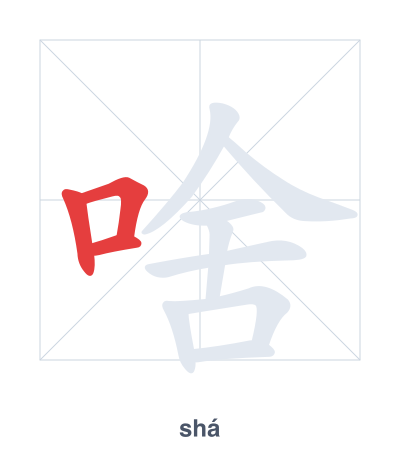
Open Hanzi Writer to see the animated stroke order and practice writing 啥 with real-time feedback.
The character 啥 (shá) is written with 11 strokes. Follow the standard Chinese stroke order: top to bottom, left to right, outside before inside. The radical 口 is one of its key components.
Practice the correct stroke order with the Hanzi Writer app to see animated stroke-by-stroke guidance with real-time feedback.
啥 means What (colloquial).
啥 is a semantic-phonetic compound. The radical 口 (mouth) indicates speech or questioning, while 舍 (shě, meaning 'house' or 'to give up') provides the sound component. It emerged as a colloquial contraction for '什麼' (shénme, 'what') in northern Chinese dialects.
💡 Memory Tip: Picture a mouth (口) sticking out of a house (舍) shouting, 'What? What's going on in there?'
你找我有啥事?
nǐ zhǎo wǒ yǒu shá shì
What do you want to see me about?
这没啥大不了的。
zhè méi shá dà bù liǎo de
This is no big deal.
你在干啥呢?
nǐ zài gàn shá ne
What are you doing?
Open Hanzi Writer to see the animated stroke order and practice writing 啥 with real-time feedback.
✨ Animated stroke order · Handwriting recognition · HSK-graded practice · Free to use
啥 is composed of the radical 口 (mouth) on the left, representing speech or asking, and 舍 (shè, house/dwelling) on the right, which gives a hint to the pronunciation "sha". The mouth radical signals that 啥 is a question word used in spoken language, like asking "What?"