颡 (sǎng) means "Forehead" in Chinese. It has 16 strokes with the radical 页.
Rated 4.2/5 in difficulty (advanced).
Appears in 3+ common words including 稽颡 (jī sǎng), 额颡 (é sǎng), 叩颡 (kòu sǎng).
Due to its 16 strokes, Hanzi Writer's error detection shows 颡 requires focused practice — most learners need 10+ attempts for consistent accuracy.
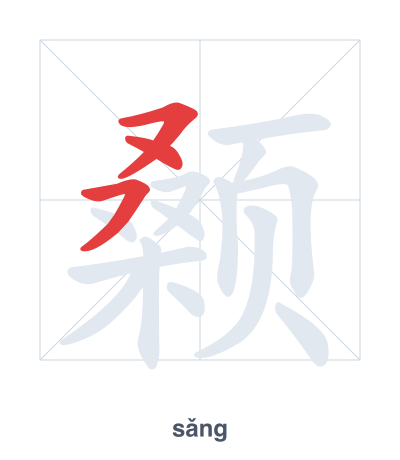
Open Hanzi Writer to see the animated stroke order and practice writing 颡 with real-time feedback.
The character 颡 (sǎng) is written with 16 strokes. Follow the standard Chinese stroke order: top to bottom, left to right, outside before inside. The radical 页 is one of its key components.
Practice the correct stroke order with the Hanzi Writer app to see animated stroke-by-stroke guidance with real-time feedback.
颡 means Forehead.
颡 is a compound character; the radical 页 (page/head) indicates the meaning relates to the head, while the phonetic component 桑 (sāng, mulberry) supplies the pronunciation. Together, they denote the forehead, the uppermost part of the face.
💡 Memory Tip: Picture a mulberry tree (桑) sprouting out of your head (页) right at the forehead, with its three branches marking the spot.
他行了一个稽颡礼。
tā xíng le yí gè jī sǎng lǐ
He performed a deep ritual bow.
他的额颡很宽。
tā de é sǎng hěn kuān
His forehead is very broad.
他向长辈叩颡。
tā xiàng zhǎng bèi kòu sǎng
He kowtowed to his elders.
Open Hanzi Writer to see the animated stroke order and practice writing 颡 with real-time feedback.
✨ Animated stroke order · Handwriting recognition · HSK-graded practice · Free to use
颡 is made of the left side 桑 (sāng, mulberry) and the right side 页 (yè, head/page). The radical 页 indicates something related to the head, so 颡 points to a specific part of the head: the forehead.