稽 (jī/qǐ) means "To examine; to investigate" in Chinese. It has 15 strokes with the radical 禾, and is HSK Level 7.
Rated 4.2/5 in difficulty (advanced).
Harder than 77% of HSK Level 7 characters.
Appears in 2+ common words including 滑稽 (huá jī), 稽首 (qǐ shǒu).
Due to its 15 strokes, Hanzi Writer's error detection shows 稽 requires focused practice — most learners need 10+ attempts for consistent accuracy.
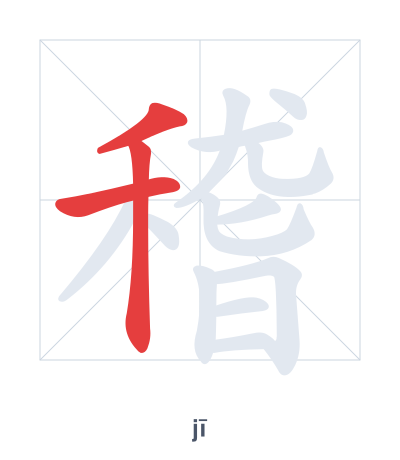
Open Hanzi Writer to see the animated stroke order and practice writing 稽 with real-time feedback.
The character 稽 (jī/qǐ) is written with 15 strokes. Follow the standard Chinese stroke order: top to bottom, left to right, outside before inside. The radical 禾 is one of its key components.
Practice the correct stroke order with the Hanzi Writer app to see animated stroke-by-stroke guidance with real-time feedback.
稽 means To examine; to investigate.
This is a polyphonic character with readings: jī, qǐ.
As an HSK Level 7 character, 稽 is an intermediate-level character.
稽 combines the radical 禾 (grain) with the components 尤 (fault) and 曰 (to say), visually suggesting an inspector speaking about faults in the grain. This reflects the character's meaning of examining or investigating carefully, originally in the context of checking crops for defects.
💡 Memory Tip: Picture a grain inspector (禾) pointing out a fault (尤) with a stern 'I say (曰) — examine this!' as he investigates.
那个马戏团小丑的表演非常滑稽逗乐。
nà ge mǎ xì tuán xiǎo chǒu de biǎo yǎn fēi cháng huá jī dòu lè
The circus clown's performance was very funny and amusing.
在古代,稽首是臣子向君王行的大礼。
zài gǔ dài qǐ shǒu shì chén zi xiàng jūn wáng xíng de dà lǐ
In ancient times, 'jishou' was a formal kowtow performed by officials to the monarch.
Open Hanzi Writer to see the animated stroke order and practice writing 稽 with real-time feedback.
✨ Animated stroke order · Handwriting recognition · HSK-graded practice · Free to use
The left side is 禾 (grain radical), which connects to agriculture and crops. The right side is a phonetic component that gives the sound jī, while the overall meaning 'to examine' likely comes from inspecting grain quality.