噻 (sāi) means "Thia- (used in chemical names) / Oh (exclamation)" in Chinese. It has 16 strokes with the radical 口.
Rated 4.2/5 in difficulty (advanced).
Appears in 3+ common words including 哇噻 (wa sāi), 噻吩 (sāi fēn), 噻唑 (sāi zuò).
Due to its 16 strokes, Hanzi Writer's error detection shows 噻 requires focused practice — most learners need 10+ attempts for consistent accuracy.
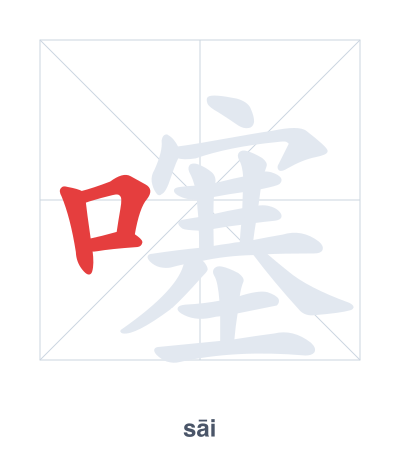
Open Hanzi Writer to see the animated stroke order and practice writing 噻 with real-time feedback.
The character 噻 (sāi) is written with 16 strokes. Follow the standard Chinese stroke order: top to bottom, left to right, outside before inside. The radical 口 is one of its key components.
Practice the correct stroke order with the Hanzi Writer app to see animated stroke-by-stroke guidance with real-time feedback.
噻 means Thia- (used in chemical names) / Oh (exclamation).
噻 is a phono-semantic compound: the radical 口 (mouth) hints at its use as an exclamation, while the component 塞 (sāi, meaning 'to block' or 'a plug') provides the pronunciation. In chemical terms, it represents the 'thia-' prefix, indicating sulfur substitution, borrowed from Greek via phonetic transcription.
💡 Memory Tip: Imagine a mouth (口) saying 'Sāi!' in surprise as someone tries to block (塞) a chemical spill with a sulfur plug.
哇噻,太漂亮了!
wa sāi tài piào liàng le
Wow, it's so beautiful!
实验室里有噻吩。
shí yàn shì lǐ yǒu sāi fēn
There is thiophene in the laboratory.
这种药含有噻唑。
zhè zhǒng yào hán yǒu sāi zuò
This medicine contains thiazole.
Open Hanzi Writer to see the animated stroke order and practice writing 噻 with real-time feedback.
✨ Animated stroke order · Handwriting recognition · HSK-graded practice · Free to use
噻 is made of the mouth radical 口 on the left and the phonetic component 塞 on the right. The 口 indicates the character is used for sounds or exclamations, while 塞 provides the pronunciation sāi. The meaning "oh" or chemical names comes from its use in transliterating foreign words.