唑 (zuò) means "Azole (a chemical suffix)." in Chinese. It has 10 strokes with the radical 口.
Rated 4.2/5 in difficulty (advanced).
Appears in 3+ common words including 咪唑 (mī zuò), 噻唑 (sāi zuò), 唑 (zuò).
Due to its 10 strokes, Hanzi Writer's error detection shows 唑 requires focused practice — most learners need 10+ attempts for consistent accuracy.
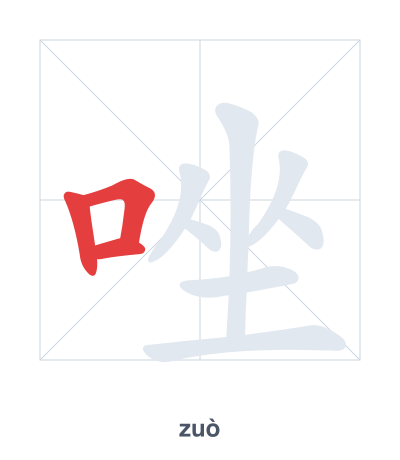
Open Hanzi Writer to see the animated stroke order and practice writing 唑 with real-time feedback.
The character 唑 (zuò) is written with 10 strokes. Follow the standard Chinese stroke order: top to bottom, left to right, outside before inside. The radical 口 is one of its key components.
Practice the correct stroke order with the Hanzi Writer app to see animated stroke-by-stroke guidance with real-time feedback.
唑 means Azole (a chemical suffix)..
唑 is a modern phono-semantic compound. The left radical 口 (mouth) hints at the chemical ring structure (like a 'mouth' shape in molecular diagrams), while the right component 坐 (zuò, 'sit') conveys the pronunciation. It was created for transliterating 'azole' in chemistry, where the mouth radical likely represents the cyclic nature of the compound.
💡 Memory Tip: Picture a chemical ring (口) where atoms 'sit' (坐) together to form an azole molecule.
咪唑是一种药。
mī zuò shì yī zhǒng yào
Imidazole is a type of medicine.
噻唑的用途很多。
sāi zuò de yòng tú hěn duō
Thiazole has many uses.
老师教我写唑字。
lǎo shī jiào wǒ xiě zuò zì
The teacher taught me how to write the character 'zuo'.
Open Hanzi Writer to see the animated stroke order and practice writing 唑 with real-time feedback.
✨ Animated stroke order · Handwriting recognition · HSK-graded practice · Free to use
唑 is made of the radical 口 (mouth) on the left and the phonetic component 坐 (zuò, meaning 'to sit') on the right. The 口 radical classifies it as a character used in chemical terminology, while 坐 provides the pronunciation. Together they form a syllable used as a suffix in chemical names for azole compounds.