Hanzi Writer

How to Write 乞 (qǐ) — Meaning “to beg”

HSK Level 7 3 strokes Radical: 乙

乞 (qǐ) means "to beg" in Chinese. It has 3 strokes with the radical 乙, and is HSK Level 7.

Rated 2.2/5 in difficulty (moderate).

Harder than 1% of HSK Level 7 characters.

Appears in 3+ common words including 乞丐 (qǐ gài), 乞求 (qǐ qiú), 乞讨 (qǐ tǎo).

Hanzi Writer's stroke validation shows learners typically need 5-8 attempts to write 乞 with correct proportion and order.
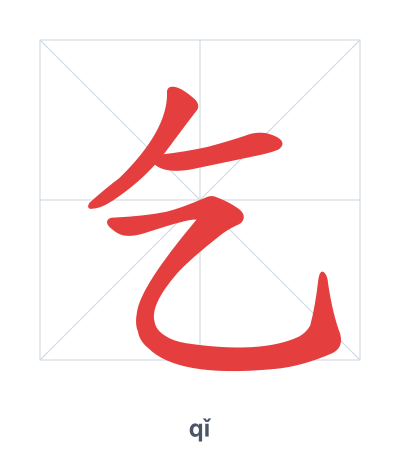
Stroke order practice for 乞 - qǐ

Practice Writing 乞 (qǐ)

Open Hanzi Writer to see the animated stroke order and practice writing 乞 with real-time feedback.

The character (qǐ) is written with 3 strokes. Follow the standard Chinese stroke order: top to bottom, left to right, outside before inside. The radical is one of its key components.

Practice the correct stroke order with the Hanzi Writer app to see animated stroke-by-stroke guidance with real-time feedback.

means to beg.

As an HSK Level 7 character, is an intermediate-level character.

Character
Pinyinqǐ (qi)
Meaningto beg
Strokes3
Radical
HSK Level7
Difficulty2.2/5

In ancient oracle bone script, 乞 depicted a person kneeling with arms raised, a gesture of supplication. Over time, the form simplified into a bent figure (radical 乙, meaning 'hook') with a diagonal stroke representing an extended hand reaching out to beg.

💡 Memory Tip: Picture a bent-over beggar (the curved top) stretching an arm down (the diagonal line) to ask for coins.

qǐ gài
beggar
qǐ qiú
to beg for; to entreat
qǐ tǎo
to beg (for food or money)

路边坐着一个乞丐。

lù biān zuò zhe yí gè qǐ gài

A beggar is sitting by the roadside.

他乞求得到大家的帮助。

tā qǐ qiú dé dào dà jiā de bāng zhù

He begged for everyone's help.

他在街上向路人乞讨。

tā zài jiē shàng xiàng lù rén qǐ tǎo

He is begging from passers-by on the street.

Character Pinyin Strokes Radical
(current) 3
5
1
miē 2
Stroke order practice for 乞 - qǐ

Practice Writing 乞 (qǐ)

Open Hanzi Writer to see the animated stroke order and practice writing 乞 with real-time feedback.

✨ Animated stroke order · Handwriting recognition · HSK-graded practice · Free to use

Frequently Asked Questions about 乞

The character 乞 is composed of the radical 乙 (a hook shape) and a left-falling stroke on top. The radical 乙 originally meant 'second' or 'hook', but here it combines with the top stroke to form a simplified image of a person bowing or reaching out, which relates to the meaning 'to beg'.

More HSK Level 7 Characters

Characters with Radical 乙

Other 3-Stroke Characters