习 (xí) means "to practice; to study; habit" in Chinese. It has 3 strokes with the radical 乙, and is HSK Level 1.
Rated 1.7/5 in difficulty (beginner-friendly).
Harder than 8% of HSK Level 1 characters.
Appears in 3+ common words including 学习 (xué xí), 习惯 (xí guàn), 练习 (liàn xí).
In the Hanzi Writer app, most learners master 习 within 3 practice attempts using stroke-by-stroke animation.
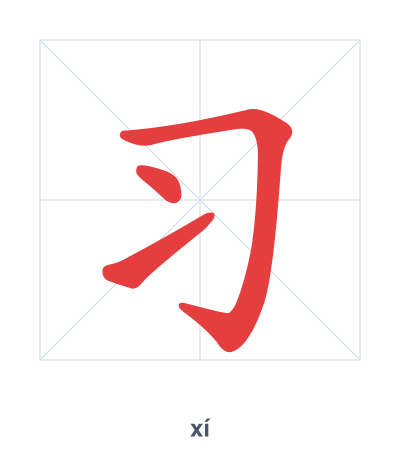
Open Hanzi Writer to see the animated stroke order and practice writing 习 with real-time feedback.
The character 习 (xí) is written with 3 strokes. Follow the standard Chinese stroke order: top to bottom, left to right, outside before inside. The radical 乙 is one of its key components.
Practice the correct stroke order with the Hanzi Writer app to see animated stroke-by-stroke guidance with real-time feedback.
习 means to practice; to study; habit.
As an HSK Level 1 character, 习 is among the first characters beginners learn.
习 is the simplified form of 習, which originally depicted a young bird flapping its wings (羽) under the sun (日) — symbolizing repeated practice until flight is mastered. The modern 习 retains the essence of a bent wing shape (radical 乙) in a simple three-stroke form, representing the habit of doing something over and over.
💡 Memory Tip: Imagine a tiny bird (the curved stroke like a wing) doing two quick flips (the two dots) to practice flying — flap, flip, fly! — that's 习.
我每天在学校学习汉语。
wǒ měi tiān zài xué xiào xué xí hàn yǔ
I study Chinese at school every day.
我习惯早上六点起床。
wǒ xí guàn zǎo shàng liù diǎn qǐ chuáng
I'm used to getting up at six in the morning.
请多做一些语法练习。
qǐng duō zuò yī xiē yǔ fǎ liàn xí
Please do more grammar exercises.
Open Hanzi Writer to see the animated stroke order and practice writing 习 with real-time feedback.
✨ Animated stroke order · Handwriting recognition · HSK-graded practice · Free to use
The character 习 is a simple 3-stroke character with the radical 乙. Its shape resembles a bird's wing, which connects to its original meaning of 'to practice' (like birds practicing flying). The top hook represents the wing curve, the dot is the head, and the bottom line is the ground.