劝 (quàn) means "to advise / to urge" in Chinese. It has 4 strokes with the radical 力, and is HSK Level 5.
Rated 2.4/5 in difficulty (moderate).
Harder than 2% of HSK Level 5 characters.
Appears in 3+ common words including 劝告 (quàn gào), 劝说 (quàn shuō), 劝架 (quàn jià).
Hanzi Writer's stroke validation shows learners typically need 5-8 attempts to write 劝 with correct proportion and order.
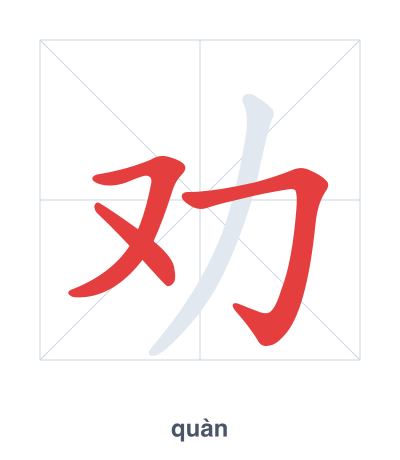
Open Hanzi Writer to see the animated stroke order and practice writing 劝 with real-time feedback.
The character 劝 (quàn) is written with 4 strokes. Follow the standard Chinese stroke order: top to bottom, left to right, outside before inside. The radical 力 is one of its key components.
Practice the correct stroke order with the Hanzi Writer app to see animated stroke-by-stroke guidance with real-time feedback.
劝 means to advise / to urge.
As an HSK Level 5 character, 劝 is an intermediate-level character.
劝 combines 又 (a hand) and 力 (strength/effort), suggesting using a hand to push someone forward with force—an image of urging or advising someone to act.
💡 Memory Tip: Imagine a hand (又) pushing you with effort (力) while telling you to follow good advice.
老师劝告我早点睡觉。
lǎo shī quàn gào wǒ zǎo diǎn shuì jiào
The teacher advised me to go to bed early.
朋友劝说我别生气。
péng yǒu quàn shuō wǒ bié shēng qì
My friend persuaded me not to be angry.
他们在吵架,我去劝架。
tā men zài chǎo jià wǒ qù quàn jià
They are arguing, and I'm going to mediate.
Open Hanzi Writer to see the animated stroke order and practice writing 劝 with real-time feedback.
✨ Animated stroke order · Handwriting recognition · HSK-graded practice · Free to use
劝 is made of 又 (hand) on the left and 力 (strength) on the right. The hand suggests action, and strength represents effort, so together they mean using effort to guide or advise someone.