加 (jiā) means "to add / plus" in Chinese. It has 5 strokes with the radical 力, and is HSK Level 2.
Rated 2.2/5 in difficulty (moderate).
Harder than 11% of HSK Level 2 characters.
Appears in 3+ common words including 参加 (cān jiā), 加油 (jiā yóu), 加班 (jiā bān).
Hanzi Writer's stroke validation shows learners typically need 5-8 attempts to write 加 with correct proportion and order.
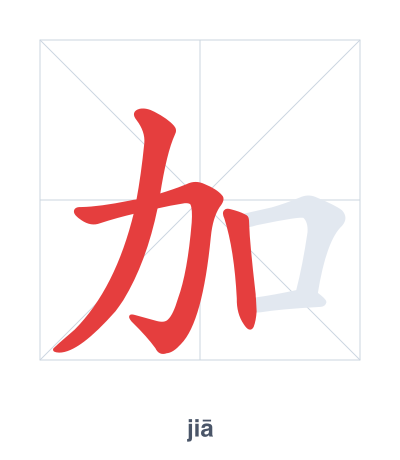
Open Hanzi Writer to see the animated stroke order and practice writing 加 with real-time feedback.
The character 加 (jiā) is written with 5 strokes. Follow the standard Chinese stroke order: top to bottom, left to right, outside before inside. The radical 力 is one of its key components.
Practice the correct stroke order with the Hanzi Writer app to see animated stroke-by-stroke guidance with real-time feedback.
加 means to add / plus.
As an HSK Level 2 character, 加 is among the first characters beginners learn.
加 combines 力 (strength) and 口 (mouth), originally showing a hand adding something to the mouth. Over time, the hand evolved into the radical for strength, conveying the idea of adding force or words to increase something.
💡 Memory Tip: Imagine a strong arm (力) shoving a plus sign (+) into a square mouth (口) to add more content.
我想参加这个比赛。
wǒ xiǎng cān jiā zhè ge bǐ sài
I want to participate in this competition.
比赛快开始了,加油!
bǐ sài kuài kāi shǐ le jiā yóu
The match is about to start, go for it!
他今天晚上要加班。
tā jīn tiān wǎn shàng yào jiā bān
He has to work overtime tonight.
Open Hanzi Writer to see the animated stroke order and practice writing 加 with real-time feedback.
✨ Animated stroke order · Handwriting recognition · HSK-graded practice · Free to use
加 is made of two parts: the left side 力 (strength) and the right side 口 (mouth). Together, they suggest using effort (力) through speaking (口) to "add" something, like cheering on someone. This structure helps explain common words like 加油 (add oil/effort) and 参加 (join in).