劢 (mài) means "put forth effort" in Chinese. It has 5 strokes with the radical 力.
Rated 2.7/5 in difficulty (moderate).
Appears in 3+ common words including 劢力 (mài lì), 劢精 (mài jīng), 勤劢 (qín mài).
Hanzi Writer's stroke validation shows learners typically need 5-8 attempts to write 劢 with correct proportion and order.
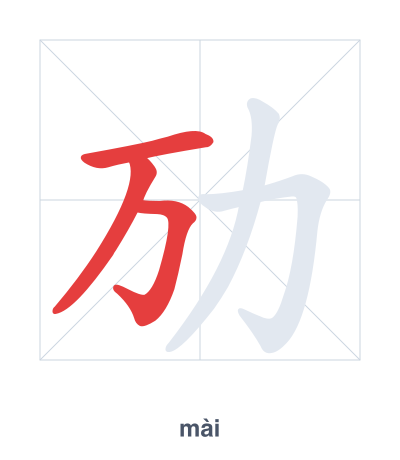
Open Hanzi Writer to see the animated stroke order and practice writing 劢 with real-time feedback.
The character 劢 (mài) is written with 5 strokes. Follow the standard Chinese stroke order: top to bottom, left to right, outside before inside. The radical 力 is one of its key components.
Practice the correct stroke order with the Hanzi Writer app to see animated stroke-by-stroke guidance with real-time feedback.
劢 means put forth effort.
劢 is a compound character combining the phonetic component 万 (wàn, meaning 'ten thousand' but here representing the sound mài) and the radical 力 (lì, 'strength/power'). The structure implies exerting one's full strength or putting forth great effort, as if summoning the power of ten thousand.
💡 Memory Tip: Picture a person using ten thousand (万) units of strength (力) to push a boulder uphill—a maximal effort.
我们要劢力前行。
wǒ men yào mài lì qián xíng
We should move forward with all our strength.
他劢精图治。
tā mài jīng tú zhì
He exerted himself to govern the country well.
勤劢的人会有收获。
qín mài de rén huì yǒu shōu huò
Diligent people will have rewards.
Open Hanzi Writer to see the animated stroke order and practice writing 劢 with real-time feedback.
✨ Animated stroke order · Handwriting recognition · HSK-graded practice · Free to use
劢 is composed of 万 (meaning 'ten thousand') on the left and 力 (meaning 'strength' or 'effort') on the right. The combination suggests putting forth ten thousand units of strength — a vivid way to express exerting great effort.