劣 (liè) means "inferior; bad" in Chinese. It has 6 strokes with the radical 力, and is HSK Level 7.
Rated 2.9/5 in difficulty (moderate).
Harder than 5% of HSK Level 7 characters.
Appears in 3+ common words including 恶劣 (è liè), 劣势 (liè shì), 优劣 (yōu liè).
Hanzi Writer's stroke validation shows learners typically need 5-8 attempts to write 劣 with correct proportion and order.
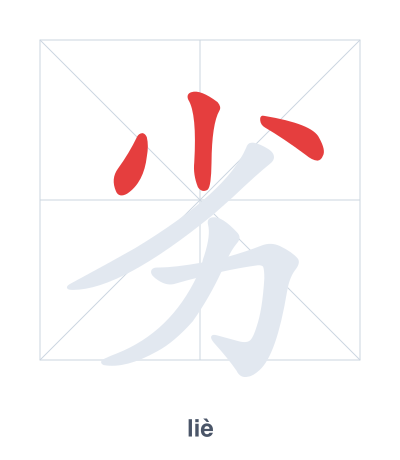
Open Hanzi Writer to see the animated stroke order and practice writing 劣 with real-time feedback.
The character 劣 (liè) is written with 6 strokes. Follow the standard Chinese stroke order: top to bottom, left to right, outside before inside. The radical 力 is one of its key components.
Practice the correct stroke order with the Hanzi Writer app to see animated stroke-by-stroke guidance with real-time feedback.
劣 means inferior; bad.
As an HSK Level 7 character, 劣 is an intermediate-level character.
劣 combines 少 (few/little) and 力 (strength/power), depicting 'little strength'—something weak or deficient in quality. This composition directly conveys the idea of being inferior or bad, as something with insufficient power or ability.
💡 Memory Tip: Picture a tiny ant (少) trying to lift a heavy weight (力), failing miserably—that's a 劣 (inferior) effort.
今天的天气很恶劣。
jīn tiān de tiān qì hěn è liè
The weather today is very bad.
我们在比赛中处于劣势。
wǒ men zài bǐ sài zhōng chǔ yú liè shì
We are at a disadvantage in the competition.
产品的优劣很重要。
chǎn pǐn de yōu liè hěn zhòng yào
The quality of the product is very important.
Open Hanzi Writer to see the animated stroke order and practice writing 劣 with real-time feedback.
✨ Animated stroke order · Handwriting recognition · HSK-graded practice · Free to use
劣 is composed of 力 (strength/power) on the bottom and 少 (few/little) on top. The combination suggests having little strength, which results in something inferior or bad. This directly reflects the character's meaning of poor quality or being at a disadvantage.