怯 (qiè) means "timid; cowardly" in Chinese. It has 8 strokes with the radical 忄, and is HSK Level 7.
Rated 3.7/5 in difficulty (challenging).
Harder than 25% of HSK Level 7 characters.
Appears in 3+ common words including 胆怯 (dǎn qiè), 怯场 (qiè chǎng), 羞怯 (xiū qiè).
Due to its 8 strokes, Hanzi Writer's error detection shows 怯 requires focused practice — most learners need 10+ attempts for consistent accuracy.
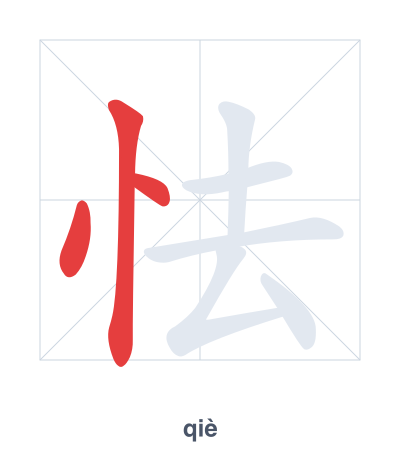
Open Hanzi Writer to see the animated stroke order and practice writing 怯 with real-time feedback.
The character 怯 (qiè) is written with 8 strokes. Follow the standard Chinese stroke order: top to bottom, left to right, outside before inside. The radical 忄 is one of its key components.
Practice the correct stroke order with the Hanzi Writer app to see animated stroke-by-stroke guidance with real-time feedback.
怯 means timid; cowardly.
As an HSK Level 7 character, 怯 is an intermediate-level character.
怯 combines the heart radical 忄 (心, xīn) with 去 (qù, 'to go' or 'depart'). The heart represents emotion or feeling, while 去 suggests the idea of withdrawing or fleeing. Together, they depict a heart that 'goes away' or shrinks back—a visual metaphor for timidity or cowardice.
💡 Memory Tip: Imagine a heart (忄) suddenly deciding to 'go' (去) hide in your stomach when you feel scared.
他感到有些胆怯。
tā gǎn dào yǒu xiē dǎn qiè
He feels a bit timid.
别在台上怯场。
bié zài tái shàng qiè chǎng
Don't get stage fright on stage.
她露出了羞怯的笑。
tā lù chū le xiū qiè de xiào
She gave a shy smile.
Open Hanzi Writer to see the animated stroke order and practice writing 怯 with real-time feedback.
✨ Animated stroke order · Handwriting recognition · HSK-graded practice · Free to use
The left side is the radical 忄 (heart), which represents emotions or feelings. The right side is 去 (qù, to go or leave), suggesting a heart that wants to run away — fitting for a character meaning timid or cowardly.