抢 (qiāng/qiǎng) means "to grab; to rob; to rush" in Chinese. It has 7 strokes with the radical 扌, and is HSK Level 5.
Rated 3.5/5 in difficulty (challenging).
Harder than 25% of HSK Level 5 characters.
Appears in 4+ common words including 抢购 (qiǎng gòu), 抢救 (qiǎng jiù), 抢走 (qiǎng zǒu).
Due to its 7 strokes, Hanzi Writer's error detection shows 抢 requires focused practice — most learners need 10+ attempts for consistent accuracy.
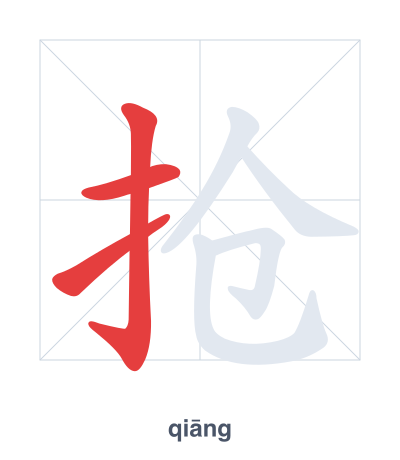
Open Hanzi Writer to see the animated stroke order and practice writing 抢 with real-time feedback.
The character 抢 (qiāng/qiǎng) is written with 7 strokes. Follow the standard Chinese stroke order: top to bottom, left to right, outside before inside. The radical 扌 is one of its key components.
Practice the correct stroke order with the Hanzi Writer app to see animated stroke-by-stroke guidance with real-time feedback.
抢 means to grab; to rob; to rush.
This is a polyphonic character with readings: qiāng, qiǎng.
As an HSK Level 5 character, 抢 is an intermediate-level character.
The character 抢 combines the radical 扌 (hand) with 仓 (granary or warehouse), suggesting a hand forcefully taking something from storage. Originally meaning 'to strike' or 'to hit', it later evolved to imply grabbing or robbing with urgency.
💡 Memory Tip: Imagine a hand (扌) snatching rice from a granary (仓) in a rush to steal it.
大家都在抢购打折货。
dà jiā dōu zài qiǎng gòu dǎ zhé huò
Everyone is rushing to buy discounted goods.
医生正在抢救病人。
yī shēng zhèng zài qiǎng jiù bìng rén
The doctor is resuscitating the patient.
他的包被抢走了。
tā de bāo bèi qiǎng zǒu le
His bag was snatched.
他悲痛地抢地呼天。
tā bēi tòng de qiāng dì hū tiān
He was so grief-stricken that he threw himself on the ground and wailed to the heavens.
Open Hanzi Writer to see the animated stroke order and practice writing 抢 with real-time feedback.
✨ Animated stroke order · Handwriting recognition · HSK-graded practice · Free to use
抢 is composed of the hand radical 扌 on the left and the phonetic component 仓 (cāng, storehouse) on the right. The hand radical indicates an action done with the hand, and together they suggest using your hand to take something from a storehouse — that is, to grab or rob.