泼 (pō) means "to splash; to sprinkle" in Chinese. It has 8 strokes with the radical 氵, and is HSK Level 5.
Rated 3.7/5 in difficulty (challenging).
Harder than 37% of HSK Level 5 characters.
Appears in 3+ common words including 泼水 (pō shuǐ), 活泼 (huó pō), 泼辣 (pō là).
Due to its 8 strokes, Hanzi Writer's error detection shows 泼 requires focused practice — most learners need 10+ attempts for consistent accuracy.
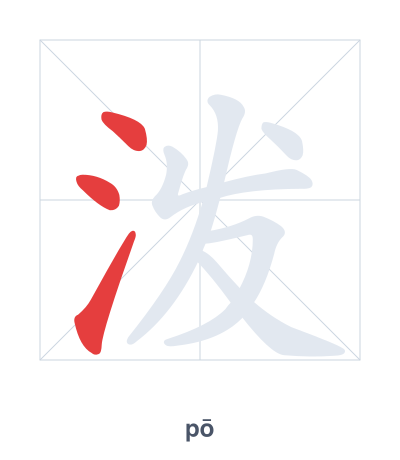
Open Hanzi Writer to see the animated stroke order and practice writing 泼 with real-time feedback.
The character 泼 (pō) is written with 8 strokes. Follow the standard Chinese stroke order: top to bottom, left to right, outside before inside. The radical 氵 is one of its key components.
Practice the correct stroke order with the Hanzi Writer app to see animated stroke-by-stroke guidance with real-time feedback.
泼 means to splash; to sprinkle.
As an HSK Level 5 character, 泼 is an intermediate-level character.
泼 is a phono-semantic compound (形声字). The left radical 氵 (water) indicates the meaning of liquid, while the right component 发 (fā, 'to send out') contributes the idea of 'projecting outward'. Together, they depict water being forcibly sent out, as in splashing or sprinkling. The character's structure visually represents the action of throwing a liquid substance.
💡 Memory Tip: Imagine a person (发) holding a bucket of water (氵) and gleefully splashing it all over the place.
在泼水节那天,人们互相泼水以表达美好的祝愿。
zài pō shuǐ jié nà tiān , rén men hù xiāng pō shuǐ yǐ biǎo dá měi hǎo de zhù yuàn 。
On the day of the Water Splashing Festival, people splash water on each other to express good wishes.
这个孩子很活泼。
zhè ge hái zi hěn huó pō
This child is very lively and active.
她的性格很泼辣。
tā de xìng gé hěn pō là
Her personality is very bold.
Open Hanzi Writer to see the animated stroke order and practice writing 泼 with real-time feedback.
✨ Animated stroke order · Handwriting recognition · HSK-graded practice · Free to use
The character 泼 combines the water radical 氵 on the left with 发 on the right. The water radical indicates that the meaning involves liquid, and 发 suggests the action of sending out or spreading. Together, they create the idea of splashing or sprinkling water outward.