呸 (pēi) means "bah! / ptooey! (expression of contempt)" in Chinese. It has 8 strokes with the radical 口.
Rated 3.7/5 in difficulty (challenging).
Appears in 3+ common words including 呸 (pēi), 呸一声 (pēi yī shēng), 呸呸 (pēi pēi).
Due to its 8 strokes, Hanzi Writer's error detection shows 呸 requires focused practice — most learners need 10+ attempts for consistent accuracy.
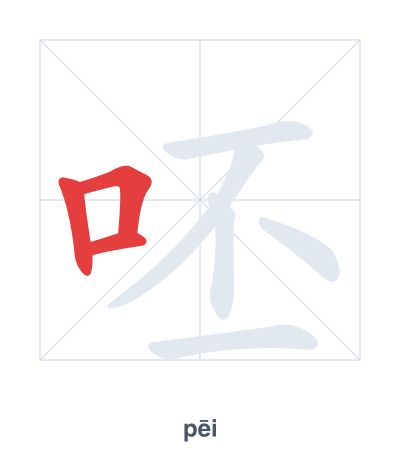
Open Hanzi Writer to see the animated stroke order and practice writing 呸 with real-time feedback.
The character 呸 (pēi) is written with 8 strokes. Follow the standard Chinese stroke order: top to bottom, left to right, outside before inside. The radical 口 is one of its key components.
Practice the correct stroke order with the Hanzi Writer app to see animated stroke-by-stroke guidance with real-time feedback.
呸 means bah! / ptooey! (expression of contempt).
This phono-semantic compound features the mouth radical (口) indicating the action or sound produced, while 不 (bù) contributes the phonetic element pēi. Together, they graphically represent the act of spitting or making a contemptuous sound through the mouth.
💡 Memory Tip: Imagine a mouth (口) spitting out a big 'No' (不) in disgust — that's the sound 'pēi!' of contempt.
呸!你别胡说八道。
pēi nǐ bié hú shuō bā dào
Bah! Don't talk nonsense.
他对着地上呸了一声。
tā duì zhe dì shàng pēi le yī shēng
He spat on the ground.
呸呸,真不吉利。
pēi pēi zhēn bù jí lì
Ptooey, how unlucky.
Open Hanzi Writer to see the animated stroke order and practice writing 呸 with real-time feedback.
✨ Animated stroke order · Handwriting recognition · HSK-graded practice · Free to use
The character 呸 is made of the radical 口 (mouth) on the left and the phonetic component 丕 (pī) on the right. The mouth radical shows this is a sound produced by the mouth, and 丕 gives the pronunciation pēi. Together, they represent the sound of spitting or expressing contempt.