螃 (páng) means "Crab (character component)" in Chinese. It has 16 strokes with the radical 虫.
Rated 4.2/5 in difficulty (advanced).
Appears in 3+ common words including 螃蟹 (páng xiè), 大螃蟹 (dà páng xiè), 吃螃蟹 (chī páng xiè).
Due to its 16 strokes, Hanzi Writer's error detection shows 螃 requires focused practice — most learners need 10+ attempts for consistent accuracy.
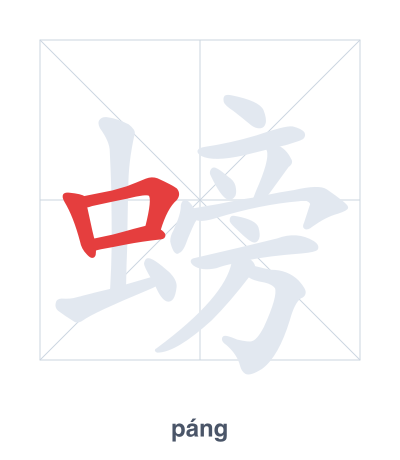
Open Hanzi Writer to see the animated stroke order and practice writing 螃 with real-time feedback.
The character 螃 (páng) is written with 16 strokes. Follow the standard Chinese stroke order: top to bottom, left to right, outside before inside. The radical 虫 is one of its key components.
Practice the correct stroke order with the Hanzi Writer app to see animated stroke-by-stroke guidance with real-time feedback.
螃 means Crab (character component).
The character 螃 combines the radical 虫 (insect/crawling creature) on the left, indicating it belongs to the animal kingdom, with the phonetic component 旁 (páng, meaning 'side') on the right. This hints at the crab's distinctive sideways walking motion, making 螃 a semantic-phonetic compound that visually and phonetically links to the creature it describes.
💡 Memory Tip: Imagine a crab (虫) scuttling sideways (旁) because it's always moving to the side—that sideways stroll is 旁's 'side' hint!
今天的螃蟹很新鲜。
jīn tiān de páng xiè hěn xīn xiān
Today's crabs are very fresh.
他买了两只大螃蟹。
tā mǎi le liǎng zhǐ dà páng xiè
He bought two large crabs.
全家人一起吃螃蟹。
quán jiā rén yì qǐ chī páng xiè
The whole family eats crabs together.
Open Hanzi Writer to see the animated stroke order and practice writing 螃 with real-time feedback.
✨ Animated stroke order · Handwriting recognition · HSK-graded practice · Free to use
The character 螃 combines the radical 虫 (meaning insect or creature) on the left and the component 旁 (páng, meaning side) on the right. This is fitting because crabs are creatures that move sideways. The right part 旁 also gives the character its pronunciation páng.