Hanzi Writer

How to Write 颞 (niè) — Meaning “Temple (of the head)”

niè 16 strokes Radical: 页

颞 (niè) means "Temple (of the head)" in Chinese. It has 16 strokes with the radical 页.

Rated 4.2/5 in difficulty (advanced).

Appears in 3+ common words including 颞部 (niè bù), 颞骨 (niè gǔ), 颞下颌 (niè xià hé).

Due to its 16 strokes, Hanzi Writer's error detection shows 颞 requires focused practice — most learners need 10+ attempts for consistent accuracy.
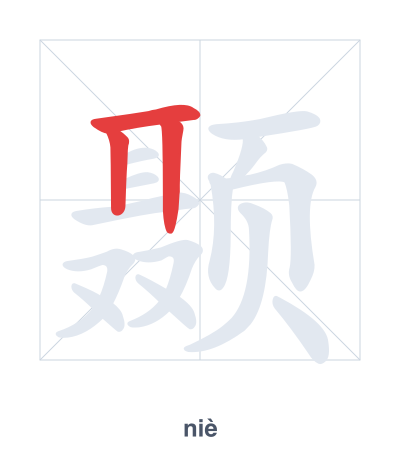
Stroke order practice for 颞 - niè

Practice Writing 颞 (niè)

Open Hanzi Writer to see the animated stroke order and practice writing 颞 with real-time feedback.

The character (niè) is written with 16 strokes. Follow the standard Chinese stroke order: top to bottom, left to right, outside before inside. The radical is one of its key components.

Practice the correct stroke order with the Hanzi Writer app to see animated stroke-by-stroke guidance with real-time feedback.

means Temple (of the head).

Character
Pinyinniè (nie)
MeaningTemple (of the head)
Strokes16
Radical
Difficulty4.2/5

颞 combines the radical 页 (head, page) as a semantic component indicating a part of the head, and the phonetic component 聂 (niè, originally meaning 'to whisper') which provides the pronunciation. The temple is the area on the side of the head near the ears, so the head radical anchors the meaning.

💡 Memory Tip: Picture your head (页) with an ear (耳) on the side where two hands (又又) press gently on your temple.

niè bù
Temporal region
niè gǔ
Temporal bone
niè xià hé
Temporomandibular

他的颞部受伤了。

tā de niè bù shòu shāng le

His temporal region is injured.

医生检查了颞骨。

yī shēng jiǎn chá le niè gǔ

The doctor examined the temporal bone.

颞下颌关节很重要。

niè xià hé guān jié hěn zhòng yào

The temporomandibular joint is very important.

Character Pinyin Strokes Radical
(current) niè 16
14
15
è 15
Stroke order practice for 颞 - niè

Practice Writing 颞 (niè)

Open Hanzi Writer to see the animated stroke order and practice writing 颞 with real-time feedback.

✨ Animated stroke order · Handwriting recognition · HSK-graded practice · Free to use

Frequently Asked Questions about 颞

颞 is composed of two parts: the left side 耳 (meaning ear) and the right side 页 (meaning head/head page). The ear points to the side of the head near the ear, and 页 relates to the head, so together they indicate the temple area of the skull.

Characters with Radical 页

Other 16-Stroke Characters