撵 (niǎn) means "to drive out; to oust; to expel" in Chinese. It has 15 strokes with the radical 扌.
Rated 4.2/5 in difficulty (advanced).
Appears in 3+ common words including 撵走 (niǎn zǒu), 撵出 (niǎn chū), 撵人 (niǎn rén).
Due to its 15 strokes, Hanzi Writer's error detection shows 撵 requires focused practice — most learners need 10+ attempts for consistent accuracy.
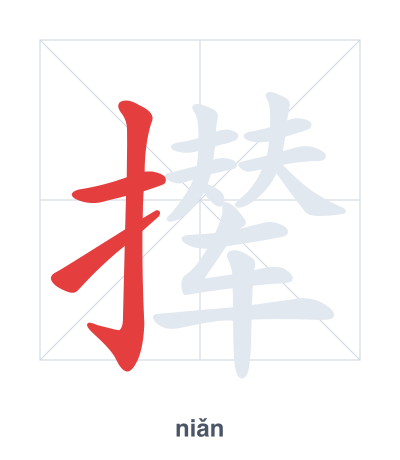
Open Hanzi Writer to see the animated stroke order and practice writing 撵 with real-time feedback.
The character 撵 (niǎn) is written with 15 strokes. Follow the standard Chinese stroke order: top to bottom, left to right, outside before inside. The radical 扌 is one of its key components.
Practice the correct stroke order with the Hanzi Writer app to see animated stroke-by-stroke guidance with real-time feedback.
撵 means to drive out; to oust; to expel.
撵 is a compound character: the left side 扌 (hand) indicates an action, while the right side 㚘 depicts two men (夫夫) pushing a cart together, symbolizing force used to drive or expel something. Historically, 㚘 itself meant 'to drive a cart,' so the combined form literally means 'to use hands to push out.'
💡 Memory Tip: Imagine a hand (扌) pushing two rowdy men (the two 夫 in 㚘) out the door to expel them from the party.
把那只猫撵走。
bǎ nà zhǐ māo niǎn zǒu
Drive that cat away.
他被撵出了房间。
tā bèi niǎn chū le fáng jiān
He was kicked out of the room.
你不能随便撵人。
nǐ bù néng suí biàn niǎn rén
You can't just drive people away.
Open Hanzi Writer to see the animated stroke order and practice writing 撵 with real-time feedback.
✨ Animated stroke order · Handwriting recognition · HSK-graded practice · Free to use
撵 is composed of the radical 扌 (hand) on the left and the phonetic component 辇 on the right. The hand radical suggests the action involves using one's hands, while 辇 originally referred to a royal carriage, giving the sense of physically pushing a vehicle or person out. Together, they create the idea of driving someone or something away by hand.