酶 (méi) means "enzyme" in Chinese. It has 14 strokes with the radical 酉.
Rated 4.2/5 in difficulty (advanced).
Appears in 3+ common words including 蛋白酶 (dàn bái méi), 辅酶 (fǔ méi), 脂肪酶 (zhī fáng méi).
Due to its 14 strokes, Hanzi Writer's error detection shows 酶 requires focused practice — most learners need 10+ attempts for consistent accuracy.
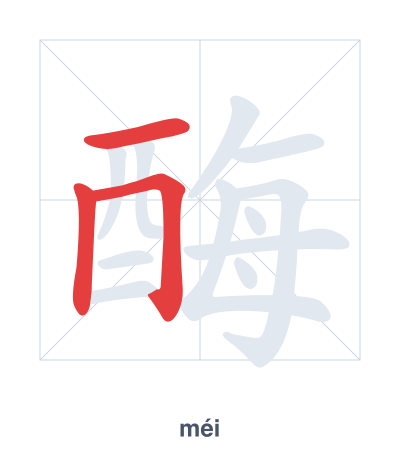
Open Hanzi Writer to see the animated stroke order and practice writing 酶 with real-time feedback.
The character 酶 (méi) is written with 14 strokes. Follow the standard Chinese stroke order: top to bottom, left to right, outside before inside. The radical 酉 is one of its key components.
Practice the correct stroke order with the Hanzi Writer app to see animated stroke-by-stroke guidance with real-time feedback.
酶 means enzyme.
酶 is a phono-semantic compound where 酉 (wine jar, fermentation) hints at enzymes' role in breaking down substances, and 每 (méi, 'every') provides the pronunciation. Enzymes were first studied in fermentation processes, linking the wine radical to their catalytic function.
💡 Memory Tip: Picture a wine jar (酉) with a little 'every' (每) enzyme inside, cheerfully munching on grape sugars to make alcohol.
蛋白酶能帮助消化。
dàn bái méi néng bāng zhù xiāo huà
Protease can help with digestion.
他在补充辅酶。
tā zài bǔ chōng fǔ méi
He is supplementing coenzymes.
脂肪酶可以分解脂肪。
zhī fáng méi kě yǐ fēn jiě zhī fáng
Lipase can break down fat.
Open Hanzi Writer to see the animated stroke order and practice writing 酶 with real-time feedback.
✨ Animated stroke order · Handwriting recognition · HSK-graded practice · Free to use
酶 is made of two parts: the radical 酉 (related to wine or fermentation) on the left, and 每 on the right, which gives the pronunciation méi. The 酉 radical hints that enzymes are involved in fermentation and biochemical reactions, like those in brewing or digestion.