肪 (fáng) means "fat (usually in 'fatty tissue')" in Chinese. It has 8 strokes with the radical 月, and is HSK Level 7.
Rated 3.7/5 in difficulty (challenging).
Harder than 30% of HSK Level 7 characters.
Appears in 3+ common words including 脂肪 (zhī fáng), 脱脂 (tuō zhī), 脂肪肝 (zhī fáng gān).
Due to its 8 strokes, Hanzi Writer's error detection shows 肪 requires focused practice — most learners need 10+ attempts for consistent accuracy.
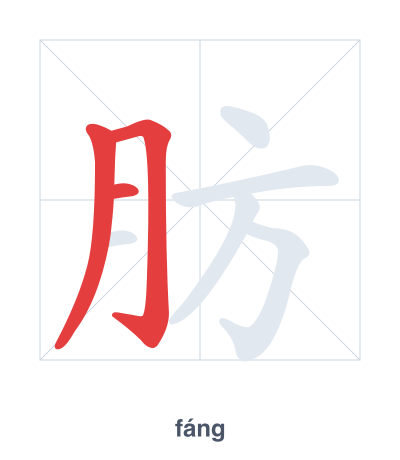
Open Hanzi Writer to see the animated stroke order and practice writing 肪 with real-time feedback.
The character 肪 (fáng) is written with 8 strokes. Follow the standard Chinese stroke order: top to bottom, left to right, outside before inside. The radical 月 is one of its key components.
Practice the correct stroke order with the Hanzi Writer app to see animated stroke-by-stroke guidance with real-time feedback.
肪 means fat (usually in 'fatty tissue').
As an HSK Level 7 character, 肪 is an intermediate-level character.
The character 肪 is a phonetic-semantic compound. The radical 月 (肉, 'meat' or 'flesh') indicates it relates to body tissue, while 方 (fāng) contributes the sound. Together, they refer to fatty tissue in animals or humans.
💡 Memory Tip: Picture a square (方) slab of meat (月) glistening with thick, white fat.
这种食物脂肪很高。
zhè zhǒng shí wù zhī fáng hěn gāo
This food is very high in fat.
这种牛奶是脱脂的。
zhè zhǒng niú nǎi shì tuō zhī de
This milk is skimmed.
他患有轻度脂肪肝。
tā huàn yǒu qīng dù zhī fáng gān
He has mild fatty liver disease.
Open Hanzi Writer to see the animated stroke order and practice writing 肪 with real-time feedback.
✨ Animated stroke order · Handwriting recognition · HSK-graded practice · Free to use
The character 肪 is made of the radical 月 (meat/flesh) on the left and the phonetic component 方 (fāng) on the right. The radical 月 indicates that the character relates to body tissue or flesh, while the entire character means 'fat' as in fatty tissue.