脂 (zhī) means "fat; grease; resin" in Chinese. It has 10 strokes with the radical 月, and is HSK Level 7.
Rated 4.2/5 in difficulty (advanced).
Harder than 83% of HSK Level 7 characters.
Appears in 3+ common words including 脂肪 (zhī fáng), 油脂 (yóu zhī), 胭脂 (yān zhī).
Due to its 10 strokes, Hanzi Writer's error detection shows 脂 requires focused practice — most learners need 10+ attempts for consistent accuracy.
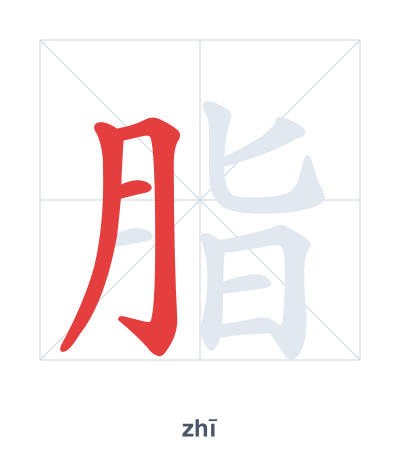
Open Hanzi Writer to see the animated stroke order and practice writing 脂 with real-time feedback.
The character 脂 (zhī) is written with 10 strokes. Follow the standard Chinese stroke order: top to bottom, left to right, outside before inside. The radical 月 is one of its key components.
Practice the correct stroke order with the Hanzi Writer app to see animated stroke-by-stroke guidance with real-time feedback.
脂 means fat; grease; resin.
As an HSK Level 7 character, 脂 is an intermediate-level character.
脂 combines the radical 月 (flesh/meat) with 旨 (meaning 'delicious' and providing phonetic zhǐ). The idea is that fat or grease is the rich, tasty part of animal flesh.
💡 Memory Tip: Imagine a slab of meat (月) so delicious (旨) that it oozes shiny, greasy fat.
这种肉脂肪很多。
zhè zhǒng ròu zhī fáng hěn duō
This meat has a lot of fat.
这种植物含有油脂。
zhè zhòng zhí wù hán yǒu yóu zhī
This plant contains oils and fats.
她涂了一点胭脂。
tā tú le yì diǎn yān zhī
She applied a bit of rouge.
Open Hanzi Writer to see the animated stroke order and practice writing 脂 with real-time feedback.
✨ Animated stroke order · Handwriting recognition · HSK-graded practice · Free to use
The left side is the radical 月 (flesh/meat), which connects to the body or animal tissue. The right side is 旨 (zhǐ), meaning "tasty" or "purpose" — together, they suggest tasty meat that is rich in fat.