蛮 (mán) means "Quite / Very" in Chinese. It has 12 strokes with the radical 虫, and is HSK Level 7.
Rated 4.2/5 in difficulty (advanced).
Harder than 88% of HSK Level 7 characters.
Appears in 3+ common words including 蛮好 (mán hǎo), 蛮快 (mán kuài), 蛮多 (mán duō).
Due to its 12 strokes, Hanzi Writer's error detection shows 蛮 requires focused practice — most learners need 10+ attempts for consistent accuracy.
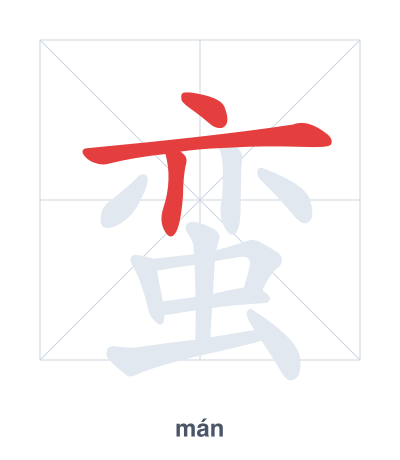
Open Hanzi Writer to see the animated stroke order and practice writing 蛮 with real-time feedback.
The character 蛮 (mán) is written with 12 strokes. Follow the standard Chinese stroke order: top to bottom, left to right, outside before inside. The radical 虫 is one of its key components.
Practice the correct stroke order with the Hanzi Writer app to see animated stroke-by-stroke guidance with real-time feedback.
蛮 means Quite / Very.
As an HSK Level 7 character, 蛮 is an intermediate-level character.
Originally meaning a southern 'barbarian' tribe, 蛮 combined 虫 (insect/snake) to evoke a region of snakes and insects, with 亦 (yì) providing phonetic hint. Over time, the word shifted to mean 'quite/very', possibly through colloquial expressions like 蛮好 (very good).
💡 Memory Tip: Imagine an insect (虫) that is also (亦) extremely annoying—so annoying it's 'quite' something.
这个苹果蛮好的。
zhè ge píng guǒ mán hǎo de
This apple is quite good.
他的车开得蛮快。
tā de chē kāi dé mán kuài
He drives his car quite fast.
这里的书蛮多的。
zhè lǐ de shū mán duō de
There are quite a lot of books here.
Open Hanzi Writer to see the animated stroke order and practice writing 蛮 with real-time feedback.
✨ Animated stroke order · Handwriting recognition · HSK-graded practice · Free to use
蛮 consists of the radical 虫 (insect) on top and the phonetic component 亦 (yì) below. The insect radical hints at the character's ancient connection to "southern barbarians" who were associated with insects or snakes, but in modern usage it means "quite" or "very."